
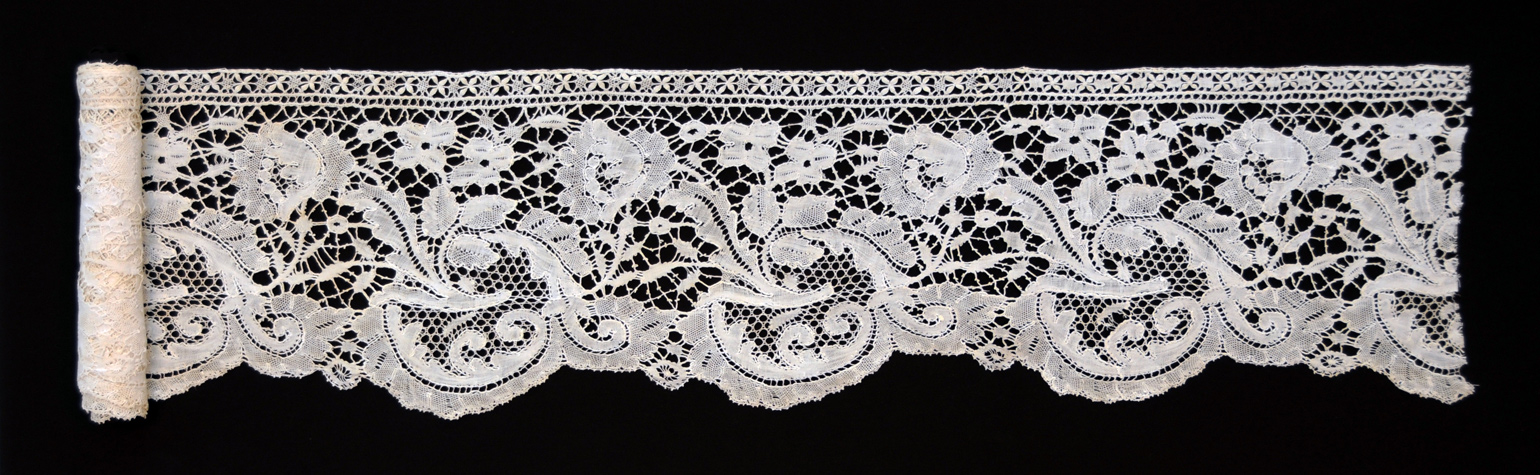
Click on the photo for a closeup view.
November’s lace is a tribute to my recent visit to Spain, where I learned a little about the vastly complex subject of guipure laces. The example shown is a 9″ wide Spanish Guipure, of which I saw many variations at the Arenys de Mar lace museum. Guipures like this were widely made throughout Europe and attribution can be very difficult. Some, like the Le Puy guipures are distinguished by their innovative grounds – in other cases there is little evidence to tell anything about origin. This piece of Spanish work is quite striking in appearance, and of good workmanship very appropriate to the style. It has a heavy florid design, a picoted irregular bride ground, and both half and whole stitch in the motifs. The elaborate header is not unusual in Spanish work. The simple star filling is typical of many Spanish laces, and can often be used to distinguish these from similar European techniques.
This piece arrived drenched in perfume – a problem quite easily solved by wrapping it in newspaper for a few days. The carbon in the ink absorbs the smell – not quite sure of the uptake chemistry here, but no more odor!
More about the museum will be written in an upcoming post.
 LaceNews