The BP Portrait awards are given in the world’s most prestigious art competition for portraiture. Artist Sophie Ploeg won the 2013 BP Travel award, and her show ‘The Lace Trail’ opens at the National Portrait Gallery in London on June 26th. Her work is truly remarkable. LaceNews took this opportunity to have an in-depth discussion with Sophie, delving into her artistry and her love of lace.
LaceNews: You must get many questions like, “Why portraits instead of some other form,” so let’s consider something different. “Why lace?” What attracts you to this most serious of textile arts?
Sophie: I love painting textures. I love painting (and showing) beauty. I find it important in my paintings that different surfaces and materials show their qualities. I might not always succeed, of course, but I try my best. In my portraits I want hair to look like hair, skin like skin and fabric like fabric and not like paint. I love pushing myself and in the past have set myself various textural challenges like water, stones, feathers and then I came upon fabrics, embroidery and… lace. I have always loved fabrics and my mother and grandmother were always busy with fabrics and thread as well, so I suppose it is in the genes. Painting fabrics and lace is something I still have not tired of and it is still a challenge. It is pure joy to be able to play with fabrics and lace and try and share the beauty of it with others via my paintings.
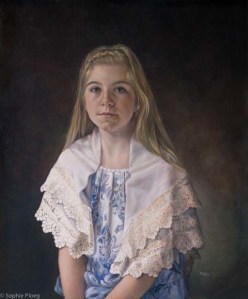
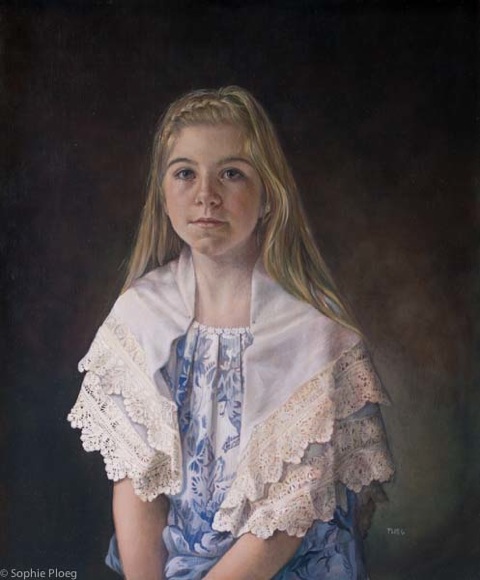
“The Lace Maker”, oil on linen, 50x60cm / 20×24″
LaceNews: You won the BP travel award, so where did you travel and what did you do for this project?
Sophie: I won the Travel Award for my proposal to study how lace and fabrics were represented in early 17th century portraiture in England and The Netherlands. I was already painting lace a lot but did not know a lot about it. Since I studied art history in my university years (MA and Ph.D) I knew I would enjoy a dive into the archives, libraries and museums to find out more. So I traveled to art collections (National Portrait Gallery, National Gallery, Rijksmuseum, Frans Hals Museum etc.), libraries, lace collections (Bath Fashion Museum, Honiton Museum, Sudeley Castle), lace makers and lace centres such as Honiton and Bruges.
The early 17th century is particularly interesting because it hinges between two art periods: the Tudor age and the Baroque. At the same time it is the period that early lace really comes into fashion and is seen extensively in portraits. Often portraits from those days show an abundance of silk, lace and embroidery, painted in spectacular fine detail. Much of the lace and the painters in early 17th century England actually came from Flanders and Holland so it made sense to continue my research in my home country and Belgium.
It was a little ironic that the V&A had closed its doors on probably the biggest lace collection in Europe. They were moving the textile department to new premises and could not allow visitors in. I therefore had to find early lace in other places and learned how little lace is displayed in museums and how often it is considered as somewhat of less interest. The lace I did find in collections was often unlabeled, or wrongly labeled, underlining once again the lack of interest from curators and directors. The hunt to be able to study authentic early lace became really interesting because of the inaccessibility of the V&A, and I learned a lot from books, studying the online collections from lace dealers, and museums as well as visits to lace shops and collections.
I traveled into the past – via extensive literary research so I could understand the history and development of early lace and early 17th century portraiture as well as spending a lot of time studying lace and paintings in museums in the UK, The Netherlands and Belgium.
During my year I have been writing blog posts of my research, travel and studio work. I decided to collect these blog posts and rewrite them into a book. The book is an accessible introduction into the history of early lace, fashion and portraiture in 17th century The Netherlands and England and a description of how I came to create the paintings for this exhibition.
After my travel and research my mind was full of ideas for paintings. I had to choose and focus on a few of them and spend a couple of months working out how to create costumes, where to source authentic lace, finding models etc etc. The book ends with a catalogue sections that shows all 10 paintings created for this project.
LaceNews: Where do the laces that you include in your portraits come from? Are you working with an expert on identification?
Sophie: Great question. I had a few ideas for my paintings and for some of them I wanted to work with authentic lace. Reproduction lace just does not look the same or is hard to find. Early lace is a little bit niche, it seems, as most books, shops and reproductions focus on the 19th century as the glory days of lace. But the early 17th century is just so interesting and the lace so charming. It has a hint of crudeness (compared to later lace) but the immensely fine thread used in mid 17th century bobbin lace or the really fine early century cutwork laces are incredibly beautiful. No reproduction lace would do.
Unfortunately the lace in museums is usually stiffly pinned to some dark fabric and even if you get to study it up close in the archives, you cannot take it to the studio to work from it. So it was difficult to find lace to work from.
I wanted to create a series of 4 portraits of modern women. Women like you and me, like us and them 400 years ago. Each modern woman got to wear a piece of authentic early lace – roughly shaped into a collar like often seen in 17th century portraits. I had to have authentic lace for this. In the end I bought some and I borrowed some from an immensely kind lace dealer. Of course the most amazing and exquisite pieces remain locked up in museums or collections. But my aim was not to show the most exquisite pieces of lace. I wanted to show how women of today are not that far removed from women who lived 400 years ago and made or wore lace. The lace is a way, a path, a doorway into the past.
I have not worked with an expert on lace identification. Lace experts are far and few between! I learned about the subject as much as I could in the short time I had. I asked questions wherever and to whomever I could. And one can get quite lost in trying to identify and date pieces of early lace, which is fantastically difficult to say the least. But I had to keep my focus and know my aim was not to become a lace expert but to create paintings that have meaning to me and, hopefully, to others – today. And for some of my paintings – like the series of women portraits – it was relevant to have correct and authentic lace, for some other paintings it did not matter whether the lace was authentic or not as I could paint what I wanted to paint and say what I wanted to say without original lace. As an artist I can interpret, play, pretend, act and re-invent. My paintings show what I want to say and show. Very often I want to share beauty and perhaps add a little bit of depth to life. Sometimes I want to say a bit more on life, on being a woman, on society, on motherhood, on the world. I love lace and I love to paint the beauty of it and through it show my audience what I see. Whether it is a piece of simple peasant lace or an elaborate Honiton does not really matter to me as it just needs to function within my picture.
LaceNews: OK, let me challenge you a bit. A painting on your website shows a not very sophisticated Battenberg lace (and that’s putting it kindly). I’m going to ask you why you chose that particular piece. Most of your viewers will be blown away by the artistry, but a lot of the serious lacemakers will be wondering, what was she thinking?
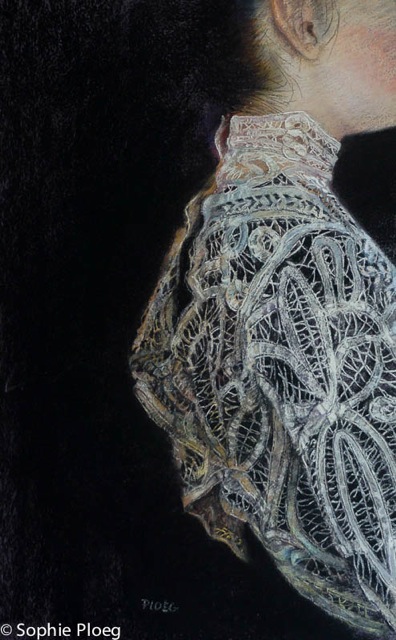
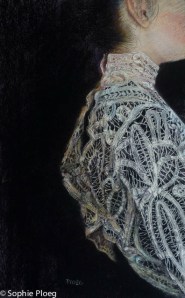 “Lace Lines”, pastel, 27x40cm / 10×16″
Sophie: LOL. What a question…;)…. It brings up something really interesting though, something I have come across all the time while working on this recent project. While lace makers will look for certain techniques and patterns, art historians (which was partly my approach for the NPG show) will be looking for authenticity, historical accuracy, style etc. Artists, on the other hand, will be looking for a certain image, an image that they have in their mind’s eye. I was not portraying a fabulously refined piece of Battenberg lace, but I was painting an image that oozes atmosphere, nostalgia, femininity; all those things do not require historical accuracy, nor refined patterns… This “crude” piece of lace fitted in the idea I had for a painting.
I also sometimes like working with damaged pieces, holes and frays….some peasant lace has a great charm. Each piece of lace gives off a different ‘flavour’ and crude and simple works can be just as beautiful as refined and complex pieces. In fact I often find the Victorian grand pieces too much, too glamorous, too…I don’t know. Early lace has a certain charm about it that is lost in Victorian lace.
If I chose to paint pieces of lace that are of interest to lacemakers (certain technique or pattern) it would be lost to most other viewers, if I chose to paint a piece of lace that is of interest to historians (certain provenance, age, style) it would also be lost on most viewers. As an artist I am not a lacemaker, a lace historian or an art historian, but an artist – creating images, pictures, ideas, visions; whatever you want to call it. If I didn’t approach it that way my art would become a pattern book or an art historical essay. I do not choose my lace based on technique, style, pattern but I choose it simply for aesthetic reasons.
LaceNews: In looking at your portraits, I’m reminded of the Dutch Masters, not only from the presence of lace, but from the mood and atmosphere of the entire look. What are the influences in your work?
Sophie: Well it would be easy to answer that; it is all because I am Dutch! That would be nonsense of course. But for the paintings in ‘The Lace Trail’ I was inspired directly by English Jacobean painters such as William Larkin and Marcus Gheeraerts the Younger (who was actually Flemish but worked here in the UK) and by Dutch masters from the early years of the 17th century such as Johannes Verspronck, Rembrandt, van Mierevelt etc. A few of my paintings for this project are directly inspired from particular paintings, taking patterns, colour schemes or lace collars from these paintings and implementing them into my own work, thereby trying to create a bridge between then and now. So the influence and inspiration is intentionally very direct and obvious.
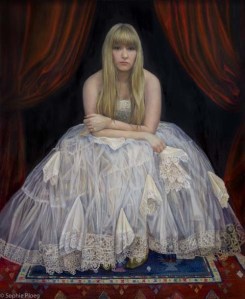
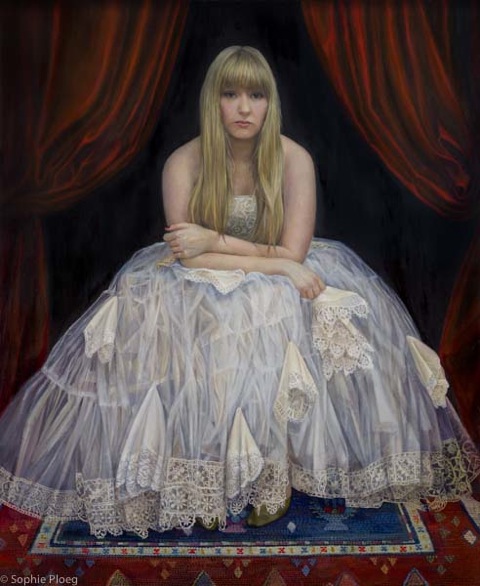
“The Handkerchief Girl”, oil on linen, 76x91cm / 30×36″
LaceNews: Will you continue with this theme in the future? What are your current inspirations for lace, and how do you approach looking at lace?
Sophie: I am far from done with lace! For ‘The Lace Trail’ I strongly restricted myself within the boundaries of the subject matter in order to be able to not get lost and keep focused. Now that the project has finished I can look further and wider. I have no need to fit my work within this project and so am freewheeling a bit. Whatever lace I find interesting or beautiful, I paint it! Whether it is brand new or ancient – it doesn’t matter. Of course I still have a huge soft spot for the 17th century and will continue to read and learn on the subject of both art history and lace history. I think it is interesting and adding value for an artist to look at fashion history with the background of being an art historian. You never know what might come out of that!
So yes I will continue to work with this theme but I will restrict myself a little less and just paint whatever grabs my heart. Lace often does. My approach to looking at lace is therefore purely aesthetic. Being an artist gives me the freedom to just go for what speaks to me. I suppose it is a matter of taste as well, but that is fine. Of course, now that I have dipped my toe (well quite a few toes!) into the history of lace I cannot resist trying to find out where a piece comes from, when it was made etc. But as we all know it is so difficult. And slightly addictive. I do know that I have fallen for the unbelievable fineness of good quality early lace. The thread is so thin, the lace so delicate, it is simply unrivaled. If only I can show you in my paintings how beautiful it is I’d be quite satisfied.
LaceNews: How does it feel to be an artist exhibiting at the National Portrait Gallery?
Sophie: Amazing. Humbling. Crazy.
I can only hope people will like my work and re-appreciate the history of lace.
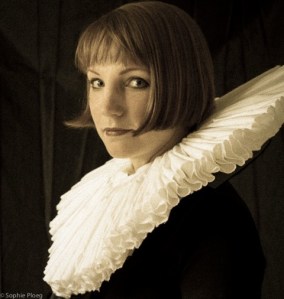
‘Sophie in 17th century style’
(Modern fashion designers should take note!)
Visit Sophie’s website at http://www.sophieploeg.com/







 LaceNews