Ebay Alerts! Eleven items – April 17, 2011

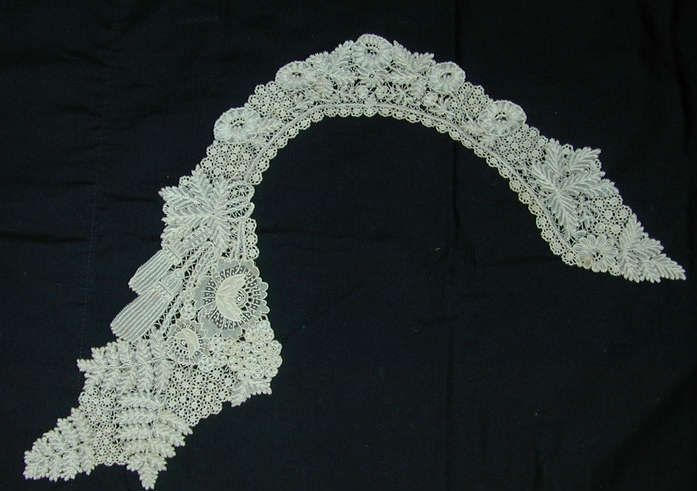
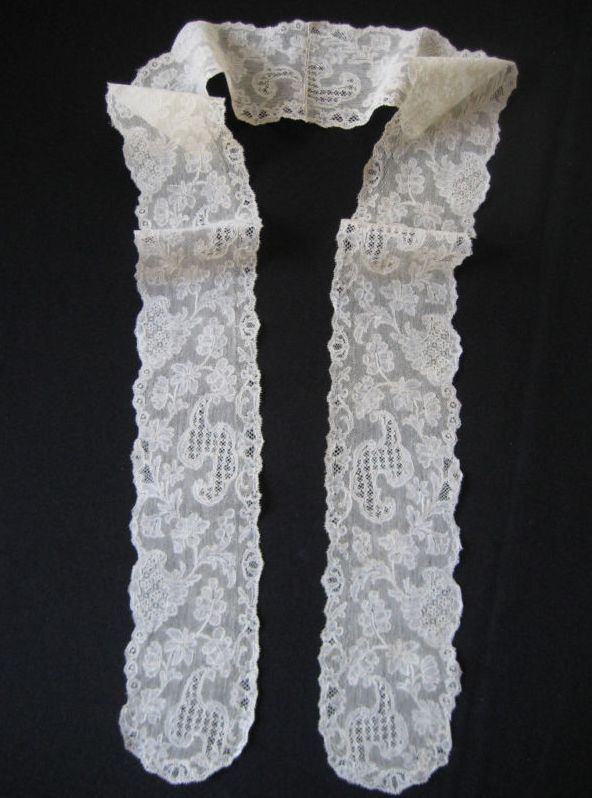
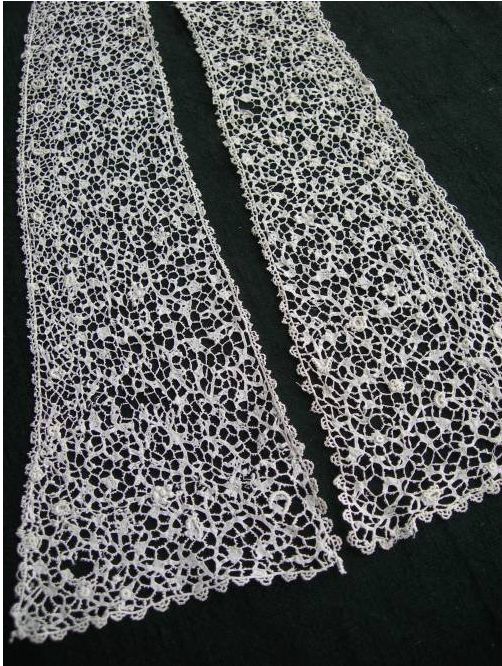
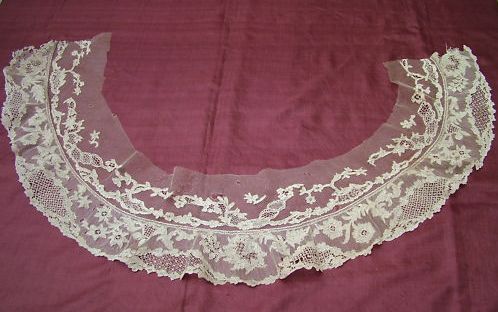
http://tinyurl.com/3oj8xp3 DAINTY HM Antique Vtg TENERIFE LACE COLLAR Dress Front
Size: 16-1/2″ x 17″, 6-1/2″ deep
Starting price: $24.99
Auction ends: Apr 19, 2011 18:43:27 PDT
Offered by: Ebay seller adtjmd, RED VELVET BENCH, United States
Comments: Nice collar of Nanduti. Good varied roundels, well executed. Seller indicates some age discoloration, and a few loose threads, nothing major.

   Sold for $43.00, 3 bidders.

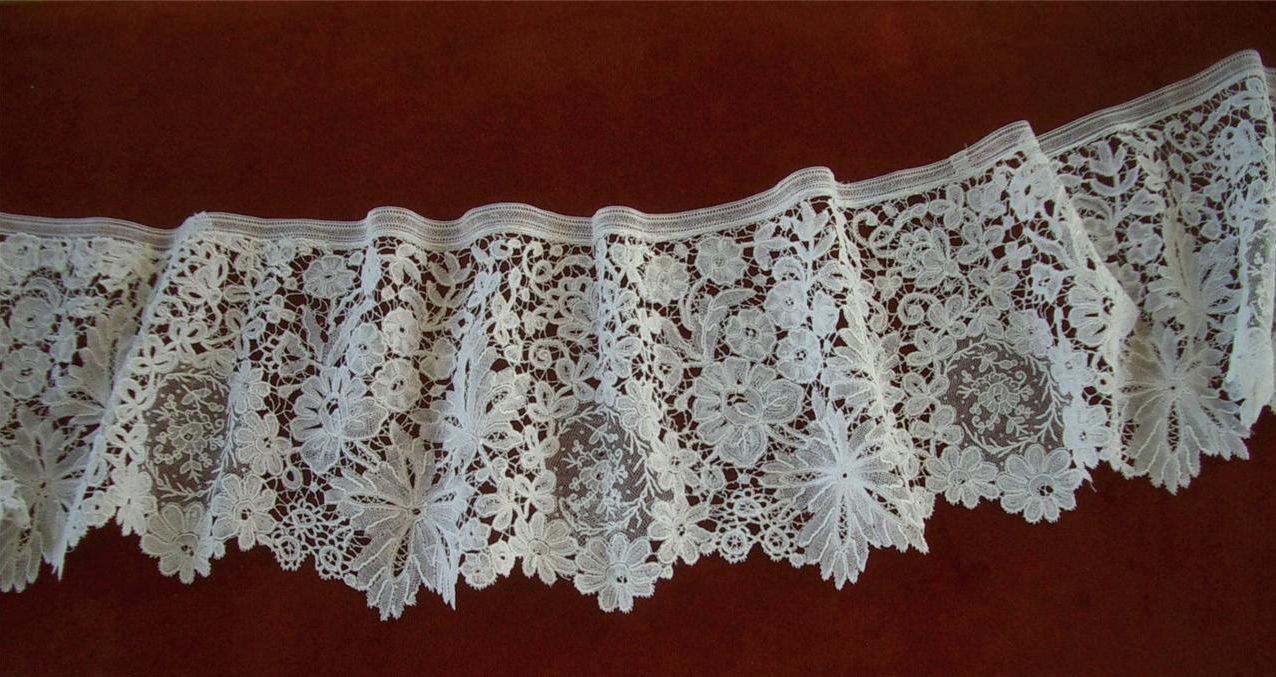
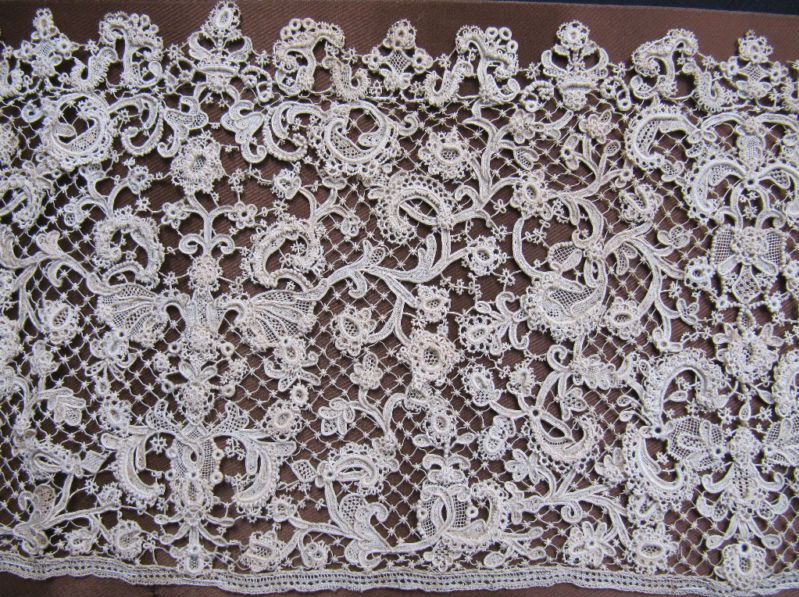
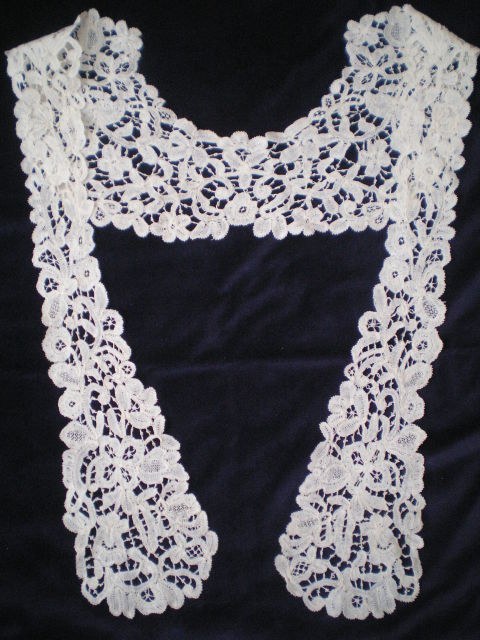
http://tinyurl.com/3czdy8r 1800’s BRUSSELS POINT DE GAZE LACE Large BERTHA COLLAR
Size: 42″ long (inside edge), 73″ long (outside edge), 1/2″ wide
Starting price: $9.99
Auction ends: Apr 19, 2011 18:59:57 PDT
Offered by: Ebay seller deonino, In Loving Memory of Capt. JOHN W. DiSTEFANO, United States
Comments: Excellent bertha. The raised petal rose design is a bit conventional, but what really makes this piece are the outstanding fillings, innovative shading in the leaves, and the wonderful overall condition. Wish all the point de gaze berthas that come up for sale could be this nice.

   Sold for $202.50, 7 bidders.

http://tinyurl.com/3jyvayh Edwardian Irish Crochet Lace Bell Sleeve Coat Jacket
Size: 24′ long, with 40″ hips, 32″ waist, 40″ bust, 16″ back and 32″ circumference sleeves
Starting price: $50.00
Auction ends: Apr 19, 2011 18:59:57 PDT
Offered by: Ebay seller 1860-1960, Moorpark, California, United States
Comments: Large motif heavy guipure Irish Crochet coat.  A few raised elements. Looks in good condition.

   sold for $499.99, 7 bidders.

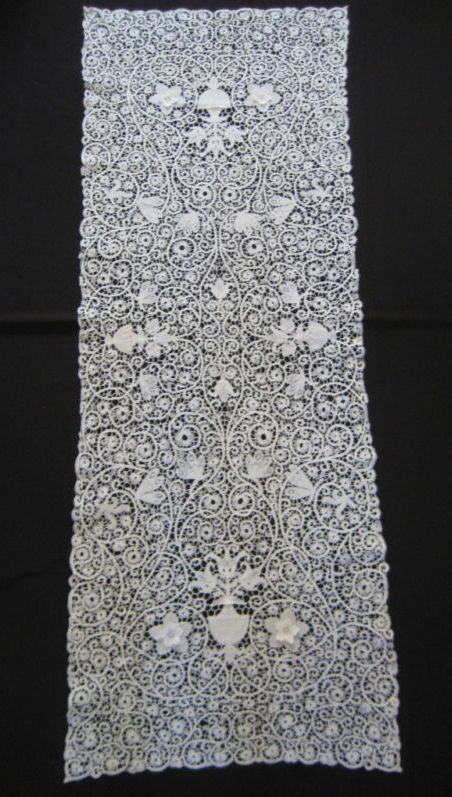
http://tinyurl.com/3jsd99y BONITO ENCAJE DEL XIX BOLILLOS A MANO.HILO SEDA.228X21
Size: 21 cm x 228 cm
Starting price: $59.00 EUR
Auction ends: 20 abr 2011 8:42:08 H.Esp
Offered by: Ebay seller malin0693, Moorpark, Comunidad Valenciana, España
Comments: Long length of black silk Le Puy guipure with a nice plaited ground.  Not an uncommon design, but there’s lots of it. Condition seems very good.

   Did not sell.

http://tinyurl.com/3o4v7hs Needlelace Square designed with Sphinx c1900
http://tinyurl.com/3suwr9h Needlealace Square designed a dragon c1900
Size: Both 18 cm x 18 cm.
Starting price: 17.00 GBP, 12.00 GBP
Auction ends: Apr 20, 2011 01:28:13 PDT
Apr 20, 2011 01:28:39 PDT
Offered by: Ebay seller lunnantiques, London, United Kingdom
Comments: I’ll put these two together becasue they are so similar.  Nice crisp needlelace design, well worked.  I’m thinking Belgium, they’ve got that WWI look to them, but probably later. Could be Italian, but not Burano.  Small figural laces like this are a collecting area all in themselves. Both look in very good condition, I can’t see any damage. Seller states they are a cream color.

     Neither sold.

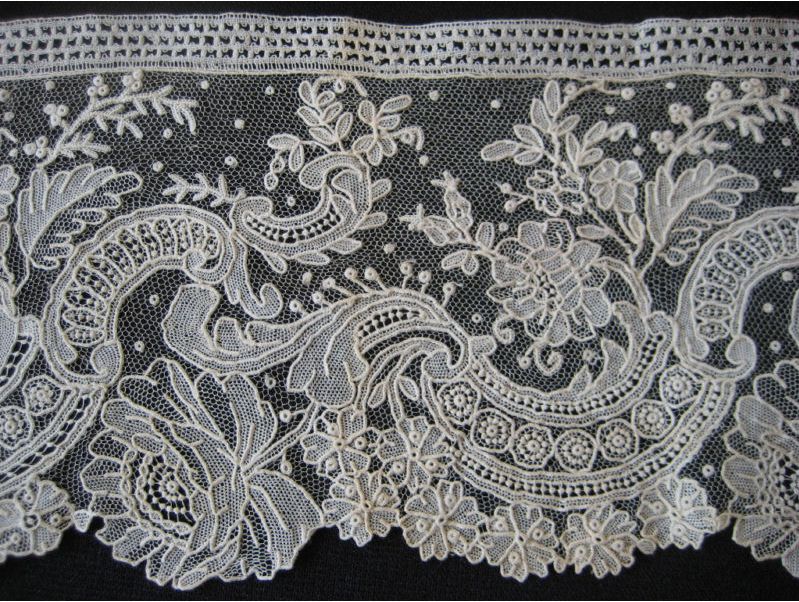
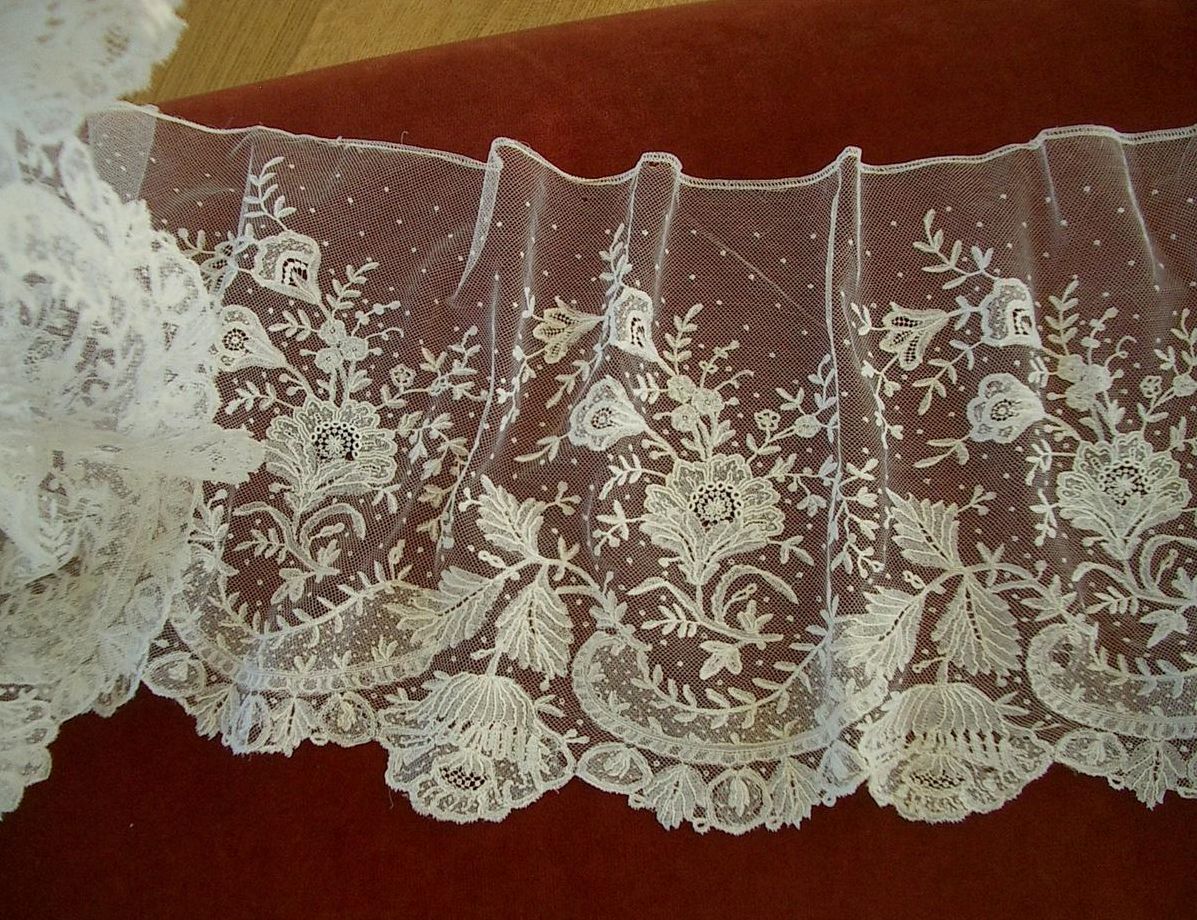
http://tinyurl.com/3rtbkvp ANTIQUE BRUSSELS BOBBIN LACE APPLIQUÉ BONNET VEIL c1880
Size: 31 1/2″ x 15 3/4″ (80cm x 40cm).
Starting price: $25.00 EUR
Auction ends: Apr 21, 2011 13:53:29 PDT
Offered by: Ebay seller klaraanna2006, Moorpark, Budapest, Hungary
Comments: Semi-circular bonnet veil of Brussels bobbinlace appliqued on machine net. Good work, note all the sprigs in the ground, sign of a better piece. Condition looks very good. I don’t see any obvious damage.

   Sold for $145.00, 2 bidders.

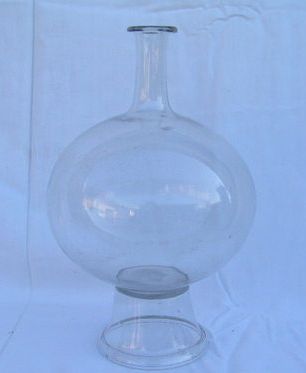
http://tinyurl.com/3lr7q6o LOUPE DE DENTELLIERE NORMANDIE XVIIIème SIECLE.H:33cm.
Size: 33 cm high
Starting price: 60.00 EUR
Auction ends: Apr 22, 2011 11:06:49 PDT
Offered by: Ebay seller touldu14, chez moi, France
Comments: Beautiful tall French lacemaker’s lamp (see my recent Collecting piece on Lighting for the Lacemaker, figure 11). Seems to be in good condition, no cracks. Note the seller shows the pontil mark on the bottom.

   Sold for 756.00 EUR, 10 bidders.   ($1,101.57)

http://tinyurl.com/3pb7v8t Rare Handmade Belgian Zele Needlelace Hand Fan
Size: 12″ x 23″
Starting price: $1,100.00
Auction ends: Apr 23, 2011 15:36:19 PDT
Offered by: Ebay seller great_stuff432, Odessa, TX, United States
Comments: It is nice, basically because of the interesting motifs.  A little coarser work than the very best flat 19th century Belgian Needlelace, but then this type of lace isn’t often used as a fan leaf.  I’ll reserve judgement on the technical description, and refer the reader to the excellent technical manuals of Irma D’hooge-Boone and Agnes Stevens. I will say that Zele needlelace comes up for auction quite regularly, and the best is superb.  I’ve visited Zele several times over the years.

   Did not sell.

http://tinyurl.com/3ldx337 ANTIQUE LACE FANTASTIC HANKIE EMBROIDERY MECHLIN C 1790
Size: 23.5″ square
Starting price: $49.99 with reserve
Auction ends: Apr 23, 201117:47:05 PDT
Offered by: Paivi Roberts, Ebay seller greatlace, Paris – Palm Beach, United States
Comments:  Not sure how I’d date this impressive piece. The beautiful Mechlin lace is mid 18th century.  I’m not well up on my whitework embroidery, but it is quite fine, does not seem to be French, and has some pulled thread work included. Perhaps India? Not sure. Condition is very good, a few stains and pinholes in the lace and small mend in the linen. We haven’t had a really good whitework embroidery handkerchief on Ebay for some time.

   Sold for $399.00, 4 bidders.

http://tinyurl.com/44zzskm 2 Antique Irish Crochet Lace Collars Dentelle 19thc
Size: inner circumference: 14.2’’/36cm hight: 2.8″/7cm
Starting price: $35.00 EUR
Auction ends: Apr 25, 2011 19:38:20 PDT
Offered by: Ebay seller sirjle, PARIS, France
Comments: I like the raised work on this piece. Actually there are 2 pieces, not wild about the second, so am only discussing the first one. Condition looks OK.

   Sold for $35.00, 1 bidder.

Posted in Ebay Alerts! | Leave a comment

Ebay Alerts! Ten items – April 14, 2011

http://tinyurl.com/3h3cwon Antique hand made unusual Carrickmacross lace 1850
Size: 9 cm x 167 cm
Starting price: 62.00 GBP
Auction ends: Apr 17, 2011 09:39:41 PDT
Offered by: Ebay seller linskapet, Kirkcudbright, Dumfries & Galloway DG6 4UU, United Kingdom
Comments: Good length of Carrickmacross Guipure. I like the design, almost looks like Honiton on the outer edge. I see a few small scattered brown spots and the occasional weakness in the cloth. But overall condition is very good.

   Did not sell.

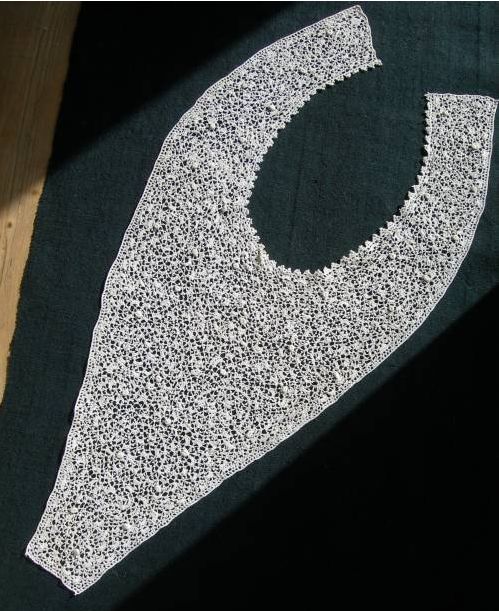
http://tinyurl.com/3wzd23b Antique handmade dress front 1890
Size: 50 cm total length, 25 cm widest part
Starting price: 62.00 GBP
Auction ends: Apr 17, 2011 10:25:45 PDT
Offered by: Ebay seller linskapet, Kirkcudbright, Dumfries & Galloway DG6 4UU, United Kingdom
Comments: Seller calls this a Breton crochet piece, but I’m not so sure about that. Early Irish crochet of the type called knotted guipure is very similar to this.  Hard to tell if this was made in this form or cut to fit. I very much like Irish crochet treated as a textile in dressmaking.

   Did not sell.

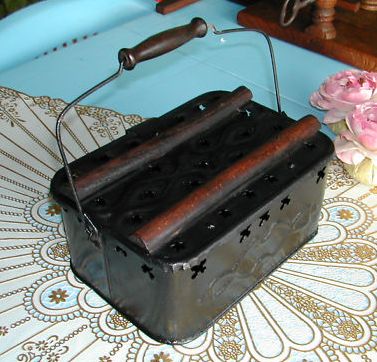
http://tinyurl.com/3fzg6f9 Superbe Chaufferette Dentelière Fuseaux Art Populaire
Size: 22 cm long, 16 cm wide, 10 cm tall
Starting price: 62.00 EUR
Auction ends: Apr 17, 2011 11:32:21 PDT
Offered by: Ebay seller barrioux, SERMENTIZON, Auvergne, France
Comments: A chaufferette footwarmer, designed to hold a basket of coals. Seller says it is from La Chaise-Dieu not far from Le Puy.  Looks in good condition, nice decorative cutouts. There is some warping of one of the wooden insulators. The piece does seem a little small, but I don’t have a lot of experience with these.

   Sold for 20.50 EUR, 2 bidders.

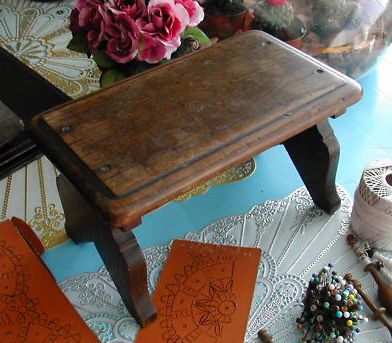
http://tinyurl.com/3fxjyok Superbe Tabouret Chêne Carreau à Dentelle Art Populaire
Size: 27 cm long, 15.5 cm wide, 15 cm tall
Starting price: 14.00 EUR
Auction ends: Apr 17, 2011 11:32:34 PDT
Offered by: Ebay seller barrioux, SERMENTIZON, Auvergne, France
Comments: So if you don’t have a chaufferette you can always use just a plain footstool. And this one is pretty plain, and sturdily built. Seller says it is from Auvergne.  Looks in good condition, some finish damage. It isn’t unreasonable to expect wear on a piece like this.

   Sold for 14.00 EUR, 1 bidder.

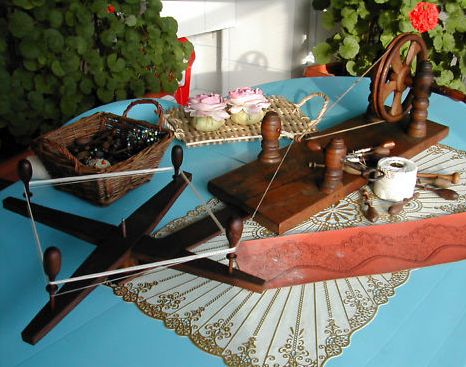
http://tinyurl.com/42yh6c8 Superbe Rouet Fuseaux Dentelle Art Populaire Velay TBE
Size: 60 cms long, 19 cms wide. Wheel diameter 20 cm.
Starting price: 28.00 EUR
Auction ends: Apr 17, 2011 11:34:06 PDT
Offered by: Ebay seller barrioux, SERMENTIZON, Auvergne, France
Comments: Interesting French bobbinwinder. Has a kind of artisinal quality to it. Note the wide carved spokes on the wheel with the wide grain pattern in the wood. I’ve stared at it for a long time, still not sure if this pattern and the wear is consistent throughout the whole piece. It is complete, and looks in very good condition.

   Sold for 72.57 EUR, 8 bidders.

http://tinyurl.com/3rs5wf4 Antique BRUSSELS POINT DE GAZE LACE Panel Scarf Flounce
Size: 8″ x 59″
Starting price: $49.99
Auction ends: Apr 17, 2011 18:07:13 PDT)
Offered by: Ebay seller adtjmd, RED VELVET BENCH, United States
Comments: Good sized length of Duchesse de Bruxelles – Duchesse bobbinlace with Point de Gaze inserts.  Pretty standard design – condition is very good.

   Sold for $127.50, 4 bidders.

http://tinyurl.com/3ppuvr5 ANTIQUE LACE HANDMADE FLOUNCE OF POINT DE GAZE C 1880
Size: 4″ x 73″
Starting price: $49.99 with reserve
Auction ends: Apr 17, 2011 18:07:13 PDT
Offered by: Paivi Roberts, Ebay seller greatlace, Paris – Palm Beach, United States
Comments: Very nice length of Belgian needlelace, no raised work. Design well above average, workmanship and condition are excellent.  Lovely piece.

   Sold for $250.00, 6 bidders.

http://tinyurl.com/3prz2zl Mint Antique Point de Gaz Intricate Lg Dress Trim Lace
Size: 30 ” around, 2.5″-5″ deep
Starting price: $9.99
Auction ends: Apr 18, 2011 15:03:48 PDT
Offered by: Ebay seller ogop, Lincoln, Massachusetts, United States
Comments: I’m not really sure how this piece works, but I like it a lot. Maybe one end mates at the head of the endpiece if you make it into a collar?  Even if not, it’s a nice design showing some innovation for Duchesse.  Looks in very good condition.  Good work on the needlelace.

   Sold for $152.50, 5 bidders.

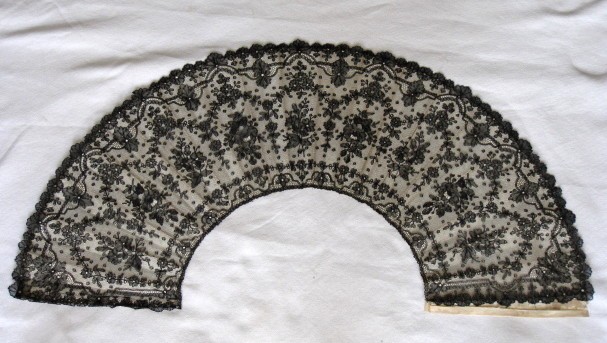
http://tinyurl.com/3csfyqt Superb Antique Chanilly Lace Fan Leaf
Size: 8″ in depth, 26″ across
Starting price: 9.99 GBP
Auction ends: Apr 19, 2011 12:00:15 PDT
Offered by: Ebay seller baraud, Newton Abbot, United Kingdom
Comments: Good Chantilly fan leaf, looks in very good condition. It is still on the fan backing although the sticks have been removed. Don’t know how difficult it might be to fully detach. Now it folds in an accordion fan mode. Nice small design in a regularly repeated pattern, maybe a little bit of shading within the roses?

   Sold for 90.88 GBP, 8 bidders.

http://tinyurl.com/43zdygr ANTIQUE LACE FABULOUS HANDMADE MECHLIN LAPPETS c 1770
Size: 3-1/2″ x 58″
Starting price: $49.99 with reserve
Auction ends: Apr 19, 2011 12:00:15 PDT
Offered by: Paivi Roberts, Ebay seller greatlace, Paris – Palm Beach, United States
Comments: This is so close! I agree with the seller, it does look like this might be a joined piece.  The inner edge in the photo below just doesn’t match the outer edge, and might be from a different piece. Joining is very subtle. Also some obvious joining at the top. Design, workmanship, condition all very good.

   $49.99, reserve not met, 1 bidder.

Posted in Ebay Alerts! | Leave a comment

Collecting: Lighting for the Lacemaker

(last update 9/23/2017, updated caption on Figure 5 about the rush hutch)

This is the first in a series of posts on objects associated with lacemaking even though that association might not always be defensible. My purpose is three-fold. First and foremost to educate the collector about some lesser known objects that actually are lace-related. Second, I attempt to trace the origins of the “lacemaker” name association for items with obviously different original functions.  It is pointless to try and convince collectors to abandon well-established names, so I take the more interesting track of trying to understand how the names evolved in the first place.  Lastly I would like explore a related subject; how objects can span the range from original to reproduction to outright fake.

These posts will be expanded as new objects come to light.  And speaking of light, that is the subject of this first post. Brian Lemin’s excellent piece on lacemaker’s lamps at http://lace.lacefairy.com/Lace/Gallery/LaceLamps.html provides much valuable information on the subject (Note, the Lace Fairy site is no longer in operation, but I’m trying to work with Brian to recover some of the posts). In view of his work I will forego an introductory discussion of glass focusing lamps, and go directly to some specialized topics.  Note also, I don’t go much into dating items. There are some claiming late 18th century origin, but this is difficult to prove. Most of these items were widely made in the 19th and early 20th century, and I will leave it to other researchers to delve into manufacturers and specific dates.  One should also keep in mind that controversy over the ‘lacemaker’ label works both ways.  One commentator on early lighting laments the fact that lacemakers always get the credit for focused lighting, even though it was used in many trades.

Lacemakers themselves often faint in horror at the practice of early lighting collectors who label certain blown glass structures as “lacemaker’s lamps” when in fact they are wick-based oil lamps.  These blown glass lamps come in a large number of forms, but share common elements of a more or less round hollow reservoir with a normally rimless opening to admit a fluid (whale oil for lighting or perhaps water for focusing). Some of the most roundly abused types are shown in Figures 1a through 1c. The reservoir ranges from spherical to a flattened sphere to triangular, but is always supported on an attached base which often has a handle. Figure 1a shows examples which come closest to a useful focusing device, and if you read further on, you will find that people have recently tried to see just how workable they might be as light condensers. A ‘peg lamp’ adaptation is shown in Figure 1b. Figure 1c shows variations on this theme which move a little too far away from a possible focusing use, but still bear the “lacemaker’s lamp” name. Many other examples can be found at the auction archive web site http://tinyurl.com/3nvtdpq.


Figure 1a. The examples are oil-based “lacemaker’s lamps” made all in one piece. The first is a 9″ tall English example that can often be found at auction. The globe is 3.4″ in diameter.  Second is a similar French “loupe or lampe de dentelliére”, where the term “loupe” means “magnifier” – also showing that the lacemaker association is not confined to English speaking countries. It has a decorative pressed glass base.
Caution, such pieces are being reproduced today. Look for a well-defined pontil mark on the bottom of the base.


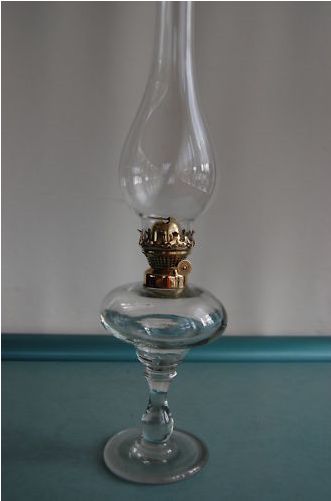
Figure 1b. Examples such as this come up occasionally, and are often labeled ‘lacemaker’s lamps’. They are also known as a ‘peg’ lamps; a glass oil lamp with a ‘peg’ at the bottom that can be inserted into a standard candlestick. The adaptation allows a candlestick to do double duty as an oil lamp. (thanks to Brian Lemin for the peg lamp attribution). I’ve found indications that this example may be French.

       
Figure 1c.  “Lacemaker’s lamp” variations – it would be difficult to use these as focusing devices. Those with handles are sometimes known as ‘finger lamps’.

In trying to trace the association of the name with this type of lamp, see Figure 2.  The photo is from collector T. L. Huetson’s “Lace and Bobbins”, first published in 1976, and the glass pieces are clearly labeled as lace-maker’s lamps. Gertrude Whiting in “Old-Time Tools & Toys of Needlework” (1928) does not mention this form in her discussion of magnified lighting.  So perhaps these two works bound the period where the name was first attached.


Figure 2. Two whale oil “lacemaker’s lamps”, one with a handle, shown with other lacemaking equipment by Heutson. As an antiques collector Heutson would have been familiar with this terminology.

In December 2010 David Springett sold a lamp similar to the first example in Figure 1a on Ebay, accompanied by a lengthy description of how it could be used as a focusing device. He went so far as to measure the focal length with candle lighting.The possibility that such a lamp could have been used as a focusing device by an enterprising lacemaker, even with the small diameter globe, may not be so far a stretch as first imagined.

Some day I’ll do a post on analyzing focal lengths through a glass shell filled with water.  It’s not so simple because of the isotropic nature of the light source, the combined index of refraction of the glass filled with water, and the irregular surface of the blown glass sphere. But the thing to remember at this point is that the focal length scales with the radius of the sphere – the larger the sphere, the farther away you can be before you lose the light concentration.  This is actually an incentive to elongate the glass bulb, which produces a larger radius in the vertical direction.

Figure 3 shows a rather staged demonstration of 19th century lacemaking (the bobbin threads are just pinned to a machine made piece of lace). But the candlestand is quite nice, showing the more accepted English form of the lacemaker’s water focusing globe. English focusing lamps generally have a projection at the bottom so that the globe can fit into a hollow cylindrical support. This helps stabilize the bulb.


Figure 3. Staged lacemaking demonstration with a magnifying candlestand. A similar example recently sold on Ebay. An English focusing lamp in this configuration is sometimes known as a “flash”.  See LaceNews Ebay Alerts for Feburary 17, 2011.

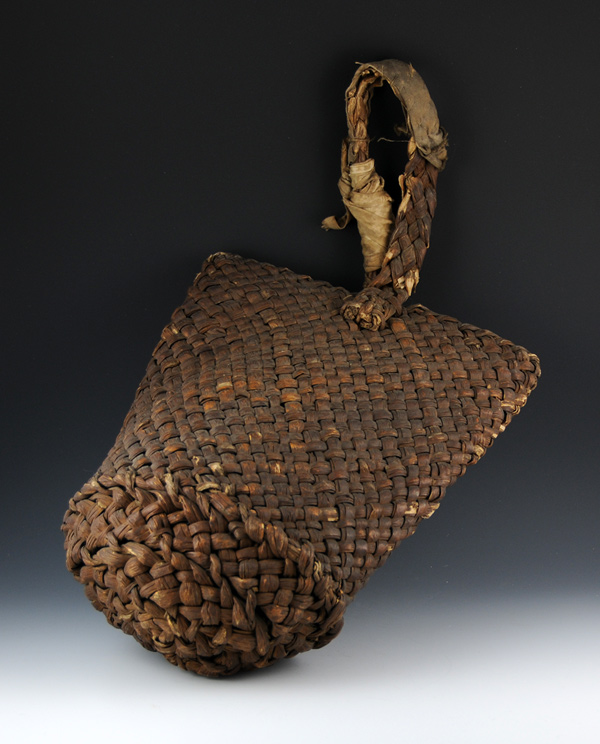
Figures 4 and 5 show English examples with their accompanying woven rush storage ‘hutches’. These hutches are often hung over a bulb support on the stand. The projection in both examples are the water filling tubes. Both can be stopped by a cork, inverted, and placed into the cylindrical recepticle on the candlestand. The elongated form seen in Figure 5 helps increase the focal length. I assume the green tint to the glass helps with some glare problem.

Much has been made of the quality of water that should fill such globes, ‘snow water’ is often sited as being of exceptional quality.  I can’t vouch for the purity of snow water or its actual composition or even if it ever fell from the sky on a cold winter’s day. Aristotle mentions distilled water, and the manufacture was described in detail by Alexander of Aphrodisias in 200 AD. That makes it a viable alternative. But I do note that the example in Figure 4 survived the trip from England to New Mexico via DHL filled with some kind of old water.  Yes, the water is very clear, although there are a few tiny black floaters and some cork fragments. The filling tube is stopped with a cork, and this example has some cracks in the glass around that site. Water can be very nasty stuff. In the presence of ultravoilet light it can dissociate into highly corrosive hydrogen peroxide and other molecules. Such pieces are best kept out of intense sunlight – and filled/stoppered globes like this do come up for sale more often that one might expect.


Figure 4.  Spherical lacemaker’s focusing lamp shown upside down with original hutch, 4-3/4″ diameter bulb.


Figure 5. Elongated, green tinted bulb with the original hutch, which is difficult to fake. The glass is 9″ long.  It is possible that this form started life as some kind of bottle.
Note, in 2017 the hutch illustrated above was borrowed by an English rush basket weaver who did an exact copy of the piece. I’ll get that photographed and posted shortly.

Figure 6 shows another variation on a focusing lamp. Here the bottom glass support is solid, and filling is accomplished by pouring water into an opening in the top stub. They are often used with a stand where the lamp support sockets are threaded into the stand base to facilitate height adjustments.  I have also seen freestanding ones where glass projection is replaced by a flat base (see figure 7). The example in figure 6 on the left is from Whiting’s book, and is described as:
“Lace-maker’s lamp from the neighborhood of Valangin, Switzerland.  The central globe holds a wick floating in oil”.
Focusing lamps were not used only by lacemakers, but by others doing fine work including engravers, watchmakers and jewelers. A Swiss origin makes sense. Valangin is both a watchmaking center and is in the canton of Neuchâtel, the Swiss lacemaking center. Gertrude Whiting herself lived in New York, was an honorary fellow of the Metropolitan Museum of Art, a Fellow of the Institute Professional Neuchâtelois de Dentelles, and founder of the Needle and Bobbin Club. So one could assume the attribution of the piece is quite solid.

The second photo is of a set so similar to the first that one is tempted to think it could actually be the Whiting piece. The central lamp seems to have been lost. It was sold on Oct 12, 2007 for $2,415 at Cowen’s Auctions (Cincinnati, Ohio, USA), and described as a
“rare wood and blown glass lacemaker’s lamp or Artisan`s Waterlight, American, 18th century, constructed of maple having the four original blown glass balls; together with eleven reproduction glass balls; 10″ high x 11″ diameter.”
I have never seen the term ‘waterlight’ used anywhere else.  I’ll just assume the cataloger was not familiar with Whiting’s book.

The third photo in Figure 6 is a very similar light arrangement, with 5 globes and a central lamp. Figure 7 shows a closeup of the lamp and a globe. It was found in England, and appears to have been ‘married’ to a three-legged stand very much like that used in English horseshoe lace stands.  The small shelf partway up is a definite later addition.  The supports for the globes screw into the base, but the threads are quite worn and don’t work very well.

I believe the Swiss attribution of the items in Figures 6 & 7 is undisputed. Particularly in view of the example dated 1830-1840 at the Musée d’histoire, La Chaux-de-Fonds in Neuchâtel. See it at http://www.imagesdupatrimoine.ch/notice/article/leclairage-des-dentellieres.html. From this example we learn that the Swiss term for the lamp is ‘globier’. And that the watchmaking industry largely replaced lacemaking in Neuchâtel, faced with increasing competition from machine lace by the mid 19th century. Marie-Louise Montadon has recently published two excellent books on Neuchâtel lace, La dentelle de Neuchâtel (1998) and Dentelles de Neuchâtel: de la production à l’exportation (2007).


Figure 6.  Left: Whiting example from Switzerland.
Middle: Possibly the same piece sold at auction in 2007.
Right: Similar piece married to what looks like an English lacemaker’s pillow stand.

  
Figure 7.  Left: Closeup of a globe and the central light from the third example shown in Figure 6. The bulb diameter is 4.5″. The globes all vary slightly in diameter.
Right:  A similar globe used with a freestanding base, 6.25″ in diameter – quite large.

Turning now to French lacemaking lamps, several differences are immediately apparent.  The radius of the glass bulb is approximately the same as in English spherical examples.  But French glasses stand upright usually on a flattened base as seen in the examples shown in Figure 8, and often come with a homemade case constructed from a bobbinlace pricking. The height of the glass was often adjusted with a stand, such as that illustrated in Figure 9. A turned wood stand 25.5 cm high recently sold on Ebay (see LaceNews Ebay Alerts for April 7, 2011). I have also seen very primitive stands just formed of a simple cone of metal, meant to secure the position of a globe without a flat base. I have also occasionally seen the word ‘doulhi’ associated with this kind of lamp, but am unsure of its origin.


Figure 8. French focusing lamps.
Left – 5.1″ diameter.
Right – 4.7″ in diameter. Note the cap on the spout. The spout itself is a little tilted, and the base isn’t quite centered. Someone has made a case for this lamp out of an old bobbinlace pattern. The whole set has so much character, whereas the first example is beautiful, but a little predictable. This bobbinlace pattern holder arrangement is not unknown, see http://tinyurl.com/3wakxyg.  Also see Figure 15 for another example.


Figure 9. This famous image has been extensively described by Claudette and Michel Bouvot in “Dentelles Normandes, Honfleur et Vire”. It is a recreation of a lacemaker working at her pillow from the Honfleur area around 1825. The costume is from the collection of the Louveau family, which can be seen today in the Eugéne-Boudin museum in Honfleur (named after the impressionist painter).
This image is perhaps the only remaining representation of equipment from the old Honfleur lace industry. Note the unique tambour pillow held between the knees. The lamp and stand are presumed original to the area.
The stand at the right is from a recent Ebay sale and strongly resembles that in the Honfleur photo, but with a larger diameter base.

The lacemaker’s lamp and stand are still objects of innovation, as shown in the Canadian example in Figure 10. This design is by Eugene Schlaak, Niagra Falls, Ontario, http://tinyurl.com/3dn53el.


Figure 10.  Modern integrated design from Canada.

Some variations on what are probably pieces meant to be used by lacemakers are shown in Figures 11 and 12.  These examples have an attached pedestal, and can be of varying height, primarily due to the different neck lengths.


Figure 11.  French footed Lacemaker’s lamp variation. The top three have an open cone-shaped foot, with necks of varying height.  Sometimes such glasses are labeled as coming from Normandy, although they can also be found in English lace literature.
The third photo is of a recently sold Ebay ‘Loupe de Dentelliére’, see http://tinyurl.com/86suhrq.  It has a similar bases, but quite an elegant elongation of the neck.
A similar object is contained in the accompanying work, “Verre d’usage et de prestige – 1500-1800″, by Jacqueline Bellanger, published in 1988. I have not read this work, so am unsure if there is a more detailed attribution. (thanks to the seller of this beautiful lamp for permission to show the photo).
Note, reproductions of such lamps are around, see http://tinyurl.com/3dzr7d and http://tinyurl.com/43z2bvl. Modern reproductions tend to have thinner glass, but still, buyer beware.

     
Figure 12.  These three examples have pedestal feet, but still retain the bulb and top opening typical of the examples in Figure 12. Such variations may have been used to focus light, and it is difficult to guess at an alternative use.
The type shown in the second example comes up surprisingly often in auctions.
The elaborate example in the last photo was purchased from a French dealer. The diameter of the sphere is 5-1/8″, which would give a longer focal length. It is quite heavy – unfortunately it arrived in the mail broken into several large pieces and several hundred smaller ones.

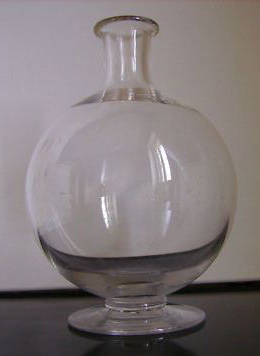
Focusing lamps can have a varied original intent, but if it works, who are we to object? The two examples shown in Figure 13 I believe are adapted from chemical laboratory glassware. The Florence flask comes in many sizes and is used to boil liquids. It is a spherical globe with a neck that varies greatly in length, and may or may not have a flattened base. These flasks are suspended by a clamp on the neck so they can be heated from below. A small lip is present at the top to stop the piece from slipping off the clamp.  Florence flasks are an interesting widely available item with which a modern lacemaker could experiment.  The third image was contributed by LaceNews reader Liz Burden, and frankly I’m not sure what it was originally for. But does magnify, as Liz nicely demonstrates.


Figure 13.  At the top are two examples of Florence flasks used as lacemaker’s focusing lamps.  The long neck helps the user swirl around a hot liquid. They can have flat or spherical bottoms, and come in many sizes.
The bottom image was contributed by Liz Burden and is the example she describes in the comment below. This is a self-sealed object, and one can only speculate on its original purpose. But it looks like it would make a good magnifier.

Figure 14 shows something you definitely don’t want to mistake for a lacemaker’s lamp, although they are often labeled as such. They are glass leech jars, used for keeping medicinal leeches.  One would cover the bowl with a muslin cloth and tie it tight just under the lip so the leech can’t climb out (having grown up around the lakes of Northern Minnesota, believe me, they will). Occasionally the lip is not present.


Figure 14.  Glass leech jars. Usually leach jar bowls are larger than the ~5″ diameter lacemaker’s focusing lamp, but they can be found in smaller sizes without the foot (see photo at
http://tinyurl.com/3nergtz). All variations are often labeled as lacemaker’s lamps.

Turning now to the light itself, figure 15 shows two examples of  ‘lacemakers lamps’ from France which do seem to be specifically designed for a lamp/globe/case set. The lamps are quite simple and unscrew at the top for filling. The wick height can be controlled by turning the nob at the side.  A variation of this form has a glass chimney as seen in the ‘chavillou’ in Figure 16.

  
Figure 15.  Left: ‘Lacemaker’s Lamp’. This seems to be a French piece.
Right: Basically the same type of lamp in combination with a focusing bottle housed in a homemade box made of a bobbinlace pricking decorated with a religious medal. This box is square, compared to the cylindrical example seen in figure 8. The glass is cylindrical, but still with a support foot. The box is lined with cotton. Both glass and the lamp are about 8 cm in diameter.


Figure 16. In Velay and Auvergne, lacemakers used a small lamp with much the same base as those shown in figure 15. It is known as a ‘chavillou’. This example is 7 inches tall. The wick is of flax tow.

Figure 17 is from Thomas Wright, “The Romance of the Lace Pillow”, plate 23. The piece is is in the Aylesbury Museum (I presume that’s the modern Buckinghamshire County museum – someone should check and see if the piece is still there), represented by Wright as having been used in the Nov. 25th St. Cattern’s day festivities. He states this festival was in celebration of the first day that lacemakers had to switch to candle lighting at the beginning of winter. He says that children had to jump over the candlestick and not put out the lighted candle – there’s a rhyme about that…

Figure 17:  Lace-maker’s Great Candlestick from Wright. 2′ 2″ high without the candle.

But generally, it can be very difficult to assign a particular lamp or candleholder to the lacemaking activity without a known provenance. I once saw a kerosene lamp in Zele, Belgium, which had been preserved by the decendents of a lace manufacturer (of the type shown in figure 20). It had been used in the workroom by the lacemakers. A remarkable provenance, but the lamp itself was not particularly unusual.

Certain candle holders of the ‘pushup’ type are sometimes known as a ‘lacemaker’s’ lamps, with the term most often referring to ones with a focusing hood. Typical examples are shown in Figure 18. The last example was provided by lace expert Diana Smith who said it was brought to the lace exhibition at the Northampton Museum in 1999 by a woman claiming it was a lacemaker’s candlestick. The candle is placed inside the cylinder with the wick through the hole in the top. A spring pushes the candle up as it burns. Again, no traceable attribution, although it does have an Art Deco look.  The other examples have the vented reflecting hood.


Figure 18.  ‘Pushup’ candle holders are sometimes combined with a reflecting element and given the ‘lacemaker’ name.
Left:  The pushup base is combined with a reflecting hood.
Middle:  Another variation, this one labeled A.Barret & Son Picadilly London. Which could imply that this type of device is English in origin.
Right:  Diana Smith sent this example of a ‘pushup’ lacemaker’s candlestick. The only thing that the rings at the top are meant to mate with is a now lost focusing hood.

See also http://www.youtube.com/watch?v=NQj3NLJPth4 for a detailed examination of a pushup candlestick with a focusing hood.

Candle reflectors also sometimes carry the name of ‘lacemaking’, and two candidates are shown in Figure 19. Items like those on the left normally come in pairs, are always of brass, and are made in the form of tilt-top tea tables. The top does tilt quite nicely, and one could imagine they could form a reflector behind a candle. But it doesn’t seem too practical, and they are rather small. Still, there are quite a few around, and the name seems to have stuck. Another item recently appeared on Ebay as a ‘Lacemaker’s Mirror’, although it looks much more like a Victorian shaving mirror. The mirror is supposed to reflect candlelight, and that might even work if the mirror is a little concave to provide some kind of focus.

 
Figure 19.  ‘Lacemaker’s lamp reflectors’.
Left: In the fully tilted position these little brass tea tables are about 5-1/2″ tall.
Right: A ‘Lacemaker’s Mirror’, although this one seems rather a stretch. The candleholders are positioned at the back, and presumably swing around front. It is implied that the light could be reflected by the mirror, which is probably magnifying.

The reflection and focusing function has been used in oil lamps, and a piece with the combined function is often termed a “lacemaker’s lamp”.  Figure 20 shows three examples of oil lamps with a focusing reflector. Reproductions are sold today, and originals aren’t too rare.


Figure 20.
  The term “lacemaker’s lamp” is accepted terminology for lamps using hemispherical reflectors.
Left: Kerosene lamp from a British maker. Date unknown.
Middle:  Brass kerosene lamp with a detachable focusing hood around the glass chimney. This example is dated around 1880.
Right: A modern copy of the focusing hood. (http://tinyurl.com/4ypd6cd)

So far we have discussed water filled globes as focusing elements, but there is no reason not to use a solid glass lens. This concept is illustrated in Figure 21, and also provides some reflection with the metal hoods over each lens directing the light downward. The pewter Gleason Bullesye lamp is often referred to as a “lacemaker’s lamp” and was made in both single and double lens variations.


Figure 21. It’s amazing how this early 19th century design has a rather ‘Klaatu Barada Nikto’ look.
Left:  Original single lens Gleason Bullseye lamp patented in the 1830s by Roswell Gleason of Dorchester, Massachusetts as a work light.
Middle: Award-winning reproduction of the Gleason Bullseye Whale Oil Lamp with double lens. (http://tinyurl.com/jjk8hfr
).
Right:  Gort.

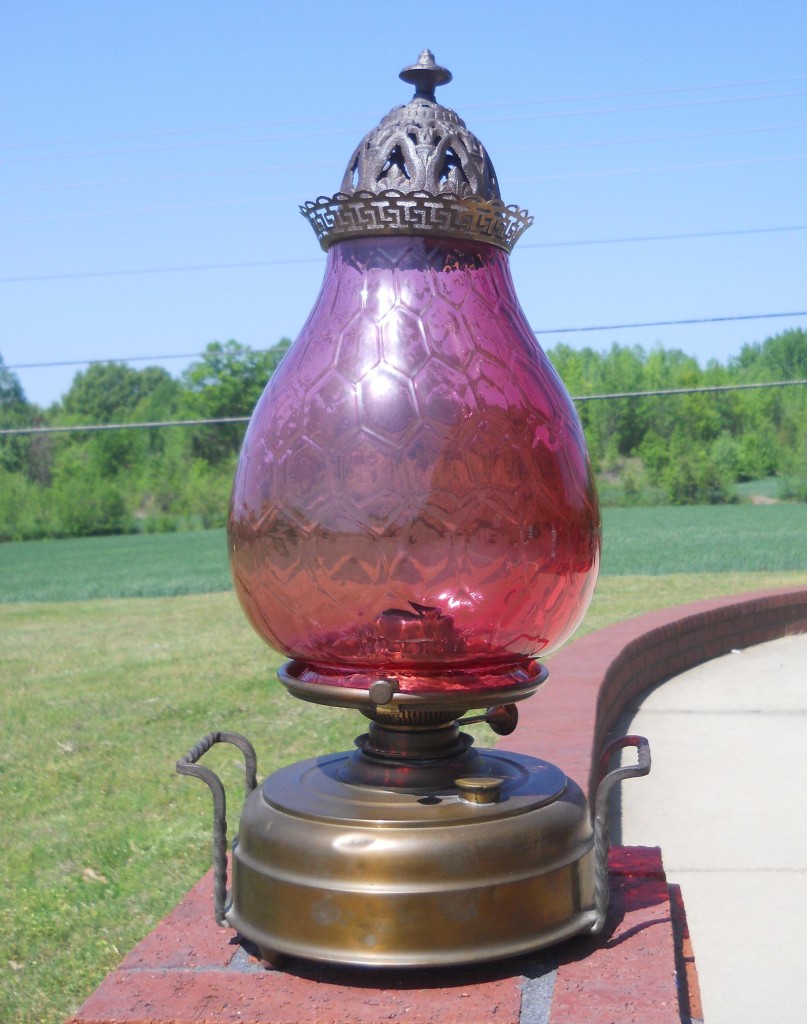
Since I started this piece, a number of people have identified photos of ‘lacemakers lamps’, which clearly have no practical use as focusing devices, and a very dubious connection with anything having to do with the craft. Figure 22 shows a few examples purely for the enjoyment of the reader.


Figure 22.  A few examples of “Lacemaker’s Lamps”, illustrating just how far sellers are willing to go with the name. The mere presence of some type of glass bulb, clear or not, seems to be enough to attach the name.

Let me close with something a little different, but still light-related.  The magnifying glass in Figure 23 is very beautiful; the lens is nearly 5″ in diameter and tinted green. It was advertised as having been used by Argentan needlelace makers, although the seller advises the purchaser to go to the museum in Argentan to see if something similar can be found. I’ll leave that as an exercise for the buyer (myself).


Figure 23. Lacemaker’s magnifying glass?

In summary, I hope this discussion will let you think a bit beyond some preconceived notions, primarily that the term “lacemaker” belongs only to those who make lace. Consider it a compliment that the term is now generally applied to a variety of reflecting and focusing devices; it is a tribute, not a deception.

No one should be upset that an object with a different original purpose was found useful to a lacemaker, and it should not automatically be assumed that some mistake has been made. Throughout the years lacemakers often could not afford specialized equipment and made do with whatever was handy (inverted coke bottles filled with water have been cited).  Enjoy the diversity of these objects, and experiment on your own, just as the adaptable and resourceful lacemakers of the past did. We stand on their shoulders, not the other way around.

Posted in Collecting | 8 Comments

Ebay Alerts! Ten items – April 10, 2011

http://tinyurl.com/3rnh8xk Armenian Bebilla Needle Lace Table Runner Handmade
Size: 12″ x 25″
Starting price: $29.99
Auction ends: Apr 12, 2011 18:36:21 PDT
Offered by: Ebay seller drb3905, Ocala, FL 34471, United States
Comments: Appears to be an excellent example of Eastern Mediterranean knotted needlelace, good size. Seller indicates two minor repairs – I can’t spot them. A very nice piece.

Sold for $40.99, 2 bidders.

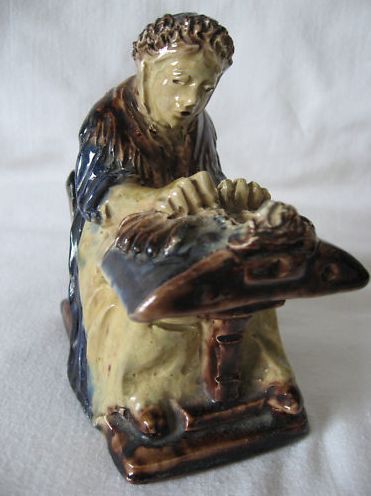
http://tinyurl.com/43epprw Spellewerkster Vlaams aardewerk Van de Voorde Brugge
Size: 10.5 cm high
Starting price: 18.00 EUR
Auction ends: Apr 13, 2011 09:15:08 PDT
Offered by: Ebay seller stekveugel, Torhout, Belgium
Comments: This is the smallest size Van de Voorde Flemish Pottery lacemaker. Condition looks good from the photos, but I’m not sure what the line “stoel 1 sport !!!” means. Perhaps a flaw in the chair?

   Sold for 18 EUR, 1 bidder.

http://tinyurl.com/3ug9o5b ANTIQUE LACE – FINE IRISH CROCHET DRESS COLLAR
Size: Not given.
Starting price: $75.00
Auction ends: Apr 14, 2011 04:48:16 PDT
Offered by: Maria Niforos, Ebay seller mithya, London-New York, United States
Comments: Good Irish Crochet collar. Four motifs – 2 different flowers and 2 different trefoils.  Good raised work, especially in flower centers. Nice quality, good condition, although I can’t tell if it was bleached.

   Did not sell.

http://tinyurl.com/3hb7wgc ANTIQUE LACE-FINE 19THC. CHANTILLY LACE
Size: 15″ x 168″
Starting price: $45.00 with reserve
Auction ends: Apr 14, 2011 04:51:21 PDT
Offered by: Maria Niforos, Ebay seller mithya, London-New York, United States
Comments: Long, wide Chantilly flounce. Typical flower and swag design, no ombré shading. Seller indicates a few openings in the net, no details, and not enough photos to tell. What is shown looks very good.

   $102.50, reserve not met, 2 bidders.
Relisted as Ebay item #160574752888.

http://tinyurl.com/3lz3z8r Loupe de dentellière. Velay. Fin 18 ème. Début 19 ème.
Size: 12 cm diameter, 14.5 cm height
Starting price: 1.00 EUR
Auction ends: Apr 15, 2011 11:08:20 PDT
Offered by: Ebay seller nourcinelle1, Midi-Pyrénées, France
Comments: Interesting French Lacemaker’s focusing lamp.  Note the slightly curved neck, and some kind of stopper that looks quite old.  Someone has made a case for this out of an old bobbinlace pattern. Small crack in the neck, and the case is pretty worn. Seller says this is from a house in Le Puy.

   Sold for 268.22 EUR, 9 bidders.

http://tinyurl.com/3mehj7g BRUSSELS BOBBIN LACE CAP BACK VRAI DROSCHEL Ca 1760
Size: 10.3″ in width.
Starting price: $10.00 with reserve
Auction ends: Apr 16, 2011 15:00:15 PDT
Offered by: Anne Swift, Ebay seller eastayton, London. England, United Kingdom
Comments: Very nice mid 18th century cap back, bobbinlace motifs on vrai droschel. Design symmetric, condition looks great. I thought perhaps that two curved pieces toward the bottom on either side have needlelace fillings in a diamond pattern… hard to tell. The seller sent me a wonderful closeup photo of this area, and it is indeed bobbinlace – extremely fine tallies in a diamond pattern. Amazing. It’s a beautiful piece.

   Sold for $460.00, 4 bidders.

http://tinyurl.com/43zy2v7 GENOESE STYLE BOBBIN LACE
Size: 5.4″ x 234″
Starting price: $10.00 with reserve
Auction ends: Apr 16, 2011 15:20:24 PDT
Offered by: Anne Swift, Ebay seller eastayton, London. England, United Kingdom
Comments: A wonderful piece, beautifully executed, very good condition, but difficult attribution. I am a little bothered by the finish; it just doesn’t have that cold-pressed density of early Italian Genoese. The long length would also be a very unusual survivor from the 16th-17th century. Seller has found several references citing a possible Italian 19th century source, perhaps Aemilia Ars.

   Sold for $450.00, 5 bidders.

http://tinyurl.com/3wkf4l3 BRUSSELS BOBBIN LACE FAN WITH MOTHER OF PEARL STICKS
Size: 5.4″ x 234″
Starting price: $10.00 with reserve
Auction ends: Apr 16, 2011 16:00:54 PDT
Offered by: Anne Swift, Ebay seller eastayton, London. England, United Kingdom
Comments: Fan leaf is a pleasing combination of 19th century Point d’Angleterre, with Point de Gaze ground, and a Duchesse guipure.  Comes with a box. I don’t see anything wrong with the lace condition, seller says some sticks have been repaired.

   Sold for $250.00, 8 bidders.

http://tinyurl.com/3nro9yb POINT DE NEIGE NEEDLE LACE 64 x 13 cms
Size: 13 cm x 64 cm.
Starting price: $10.00 with reserve
Auction ends: Apr 16, 2011 16:30:02 PDT
Offered by: Anne Swift, Ebay seller eastayton, London. England, United Kingdom
Comments: Delightful length of late 19th century rosaline, perhaps from the Jesurum factory in Venice.   From the June Page collection.  Jesurum still exists, I visited there years ago and was given a piece of a similar lace. I was told how the lacemakers would be selected for each part of the manufacturing process mainly by the size of their hands.
I just wish there were more of this piece – stunning work.

   Sold for $517.00, 5 bidders.

http://tinyurl.com/3vn5avr ENGLISH HONITON BOBBIN LACE TOTALLY HANDMADE 19th c
Size: 7.5″ x 210″
Starting price: $10.00 with reserve
Auction ends: Apr 16, 2011 16:50:09 PDT
Offered by: Anne Swift, Ebay seller eastayton, London. England, United Kingdom
Comments: Good long length of Honiton with needlemade ground.  Motifs are crisp and clean.  Condition appears excellent.

   $127.50, reserve not met, 4 bidders.

Posted in Ebay Alerts! | 1 Comment

Auction: Drouot – Week of April 9, 2011

Linge, dentelles, tissus, bagages et accessoires de mode
Date: Saturday, April 9, 2011
Place:
1725, route de Riottier, 1430
Villefranche-sur-Saone, France
Time: Auction begins at 2:30 PM
Web Page:
http://tinyurl.com/3cycozs
Auction by: Rhône Alpes E.R.A, SVV – Tél. 04.74.09.44.10
Notes: Brussels, Burano and Venetian lace, no online photos or catalog. Additional textiles and costumes.

Linge, et dentelles
Date: Wednesday, April 13, 2011
Place:
Salle 10 – Drouot-Richelieu
9, rue Drouot – 75009, Paris
Time: Auction begins at 2:00 PM
Web Page:
no details available.
Auction by: Kalck et associés, SVV, 8, rue Drouot, 75009 Paris
Tél.  01.47.70.04.19, Fax. 01.47.70.08.60, kalck.associes@orange.fr
Notes: I can find nothing more than the title.

Drouot is an organization of auction houses throughout France, including their main facility, the Hôtel Drouot in the 9th arrondissement of Paris. Established in 1852, Hôtel Drouot held a monopoly on French antiques auctions until legal reforms opened the way for international competition in 2000.  The Gazette Drouot http://www.gazette-drouot.com/ lists upcoming auctions, and I will post those which indicate lace offerings.
Online bidding: All bidders must first register with Drouot. Go to https://drouotonline.webzone-secure.org/creationdecompte to create an account. Login at http://www.drouotonline.com/ for online auctions, or http://www.drouotlive.com/ for live auctions on the net. You also have to register for individual auctions.  I haven’t tried this yet, so please comment if you have experience. There are many videos (in French) explaining the process:
http://www.drouot.com/static/drouot_video_sommaire.html?lang=en

Posted in Auctions | Leave a comment

Auction: Embroideries, Costume, Textiles, Lace & Fans, Bonhams Knowle – April 12, 2011

Sale 18803 – Embroideries, Costume, Textiles, Lace & Fans
Date:
Tuesday, April 12, 2011
Place:
Bonhams Knowle Salesroom
Dorridge, Solihull, West Midlands B93 0HT, UK
http://www.google.com/maps?q=B93+0HT&hl=en
Time: Auction begins at 11:00 AM
Web Catalog:
http://www.bonhams.com/EUR/auction/18803/
Specialist:
Claire Browne, Claire.Browne@bonhams.com, +44 1564 732969

Bonhams has Textile auctions including lace several times a year. The April 12th auction includes 48 lace lots. Lot 1 is a very good early 18th century Brussels Bobbinlace cap back.   Lots of named and inscribed bone bobbins in lots 45 and 48.  Some interesting collars in lots 32 and 35.
Bidding:
All bidders must first register with Bonhams at http://tinyurl.com/3ppx7fn
See http://www.bonhams.com/eur/HowToBuy/ for detailed bidding instructions.
Payment: Sterling check, cash, banker’s draft, or bank transfer.
Debit card UK bank, no charge. 3% surcharge on overseas bank or deferred debit cards.  Mastercard or Visa (3% surcharge).
Charges: Buyer’s premium is 20% of the hammer price on the first 250,000 GBP
VAT at current rates (20%) is added separately, where applicable.

The next regular Bonhams Embroideries, Costume, Textiles, Lace & Fans auction will be July 26, 2011.

Posted in Auctions | Leave a comment

Ebay Alerts! Eight items – April 7, 2011

http://tinyurl.com/4yy8qqx 2 antique Point de France needle lace panels 1680-1690
Size: each 58 cm long; 7cm wide one end, 12 cm wide opposite end
Starting price: 180.00 GPB
Auction ends: Apr 10, 2011 10:05:11 PDT
Offered by: Ebay seller linskapet, Kirkcudbright, Dumfries & Galloway DG6 4UU, United Kingdom
Comments: These pieces have more the random design appearance of Italian Corraline; but it is always hard to tell the difference between French and Italian products of this period. I’ve stared at these a lot, especially the edges. They have a bit of a messy remade look especially along one edge, but it would have been done early on. In that case they are probably lappets – they do have appropriate lengths and widths. Some localized damage.

. Did not sell.
Relisted Ebay #200596613600

http://tinyurl.com/3gp22ms LOVELY H/M CANTU LACE RUNNER BUTTERFLIES & 3D FLOWERS
Size: 52″ x 19″
Starting price: $44.99
Auction ends: Apr 10, 2011 17:49:11 PDT
Offered by: Paivi Roberts Ebay seller greatlace, Paris – Palm Beach, United States
Comments: Good Cantu runner with design of butterflies and raised flowers. Typical scrolls and trefoil flower heads.  Condition looks very good.

Sold for $374.99, 6 bidders.

http://tinyurl.com/3kacxwl EXQUISITE EDWARDIAN NEEDLELACE POINT DE GAZE COLLAR
Size: 15″ neck, 8 1/2″ from the top of the collar to the point. Width ~37 1/2″
Starting price: $9.99
Auction ends: Apr 10, 2011 18:00:53 PDT
Offered by: Ebay seller i*mtrying, San Anselmo, California, United States
Comments: Several of the photos of this piece are taken from the wrong side, so it’s actually a lot better than it sometimes looks.  A distinctive technique, clothwork rather open, note the windows in the rose petals. No raised work, limited fillings, and design is a little informal. Condition very good, few minor pinholes. Overall a nice looking piece.

Sold for $122.50, 6 bidders.

http://tinyurl.com/3pxkr5z Antique Vtg BRUSSELS APPLIQUE NET LACE Flounce *98in
Size: 10-1/2″ x 98″
Starting price: $49.99
Auction ends: Apr 10, 201118: 06:47 PDT
Offered by: Ebay seller adtjmd, RED VELVET BENCH, United States
Comments: Good wide length of Brussels application on machine net. Good design, typical romantic swags and flowers.  Needlelace seems confined to a few fillings. Very reasonable condition, I can see a few minor pinholes, and seller has more details.

Sold for $255.00, 6 bidders.

http://tinyurl.com/4433str Antique early Alencon needlelace h/made length….study
Size: 5″ wide, 44″ around bottom edge.
Starting price: 24.99 GBP
Auction ends: Apr 11, 2011 08:09:57 PDT
Offered by: Ebay seller discover4, London, United Kingdom
Comments: A ‘married piece’.  Lovely border of mid 18th c Alençon, few holes in the net. Upper piece is an early needlelace appliqued onto what looks like machine net.  Excellent study piece.

Sold for 80.99 GBP, 3 bidders.

http://tinyurl.com/3qq5zjy Lovely Piece of Antique Handmade Lace(Bertha+ Lappets)
Size: 85″ total length
Starting price: 24.99 GBP
Auction ends: Apr 11, 2011 11:44:18 PDT
Offered by: Ebay seller isohex, Sunderland, United Kingdom
Comments: Good collar with attached lappets, Belgian Bruges-type pieced lace. Nicely worked, condition looks excellent. This kind of lace is often disappointing in design, but this is a very nice example.

Sold for 24.99 GBP, 1 bid.

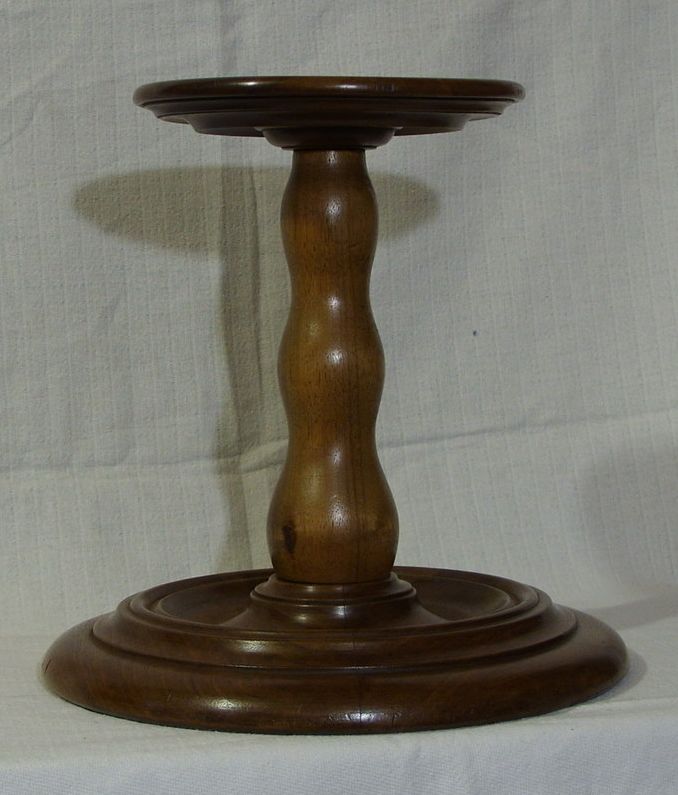
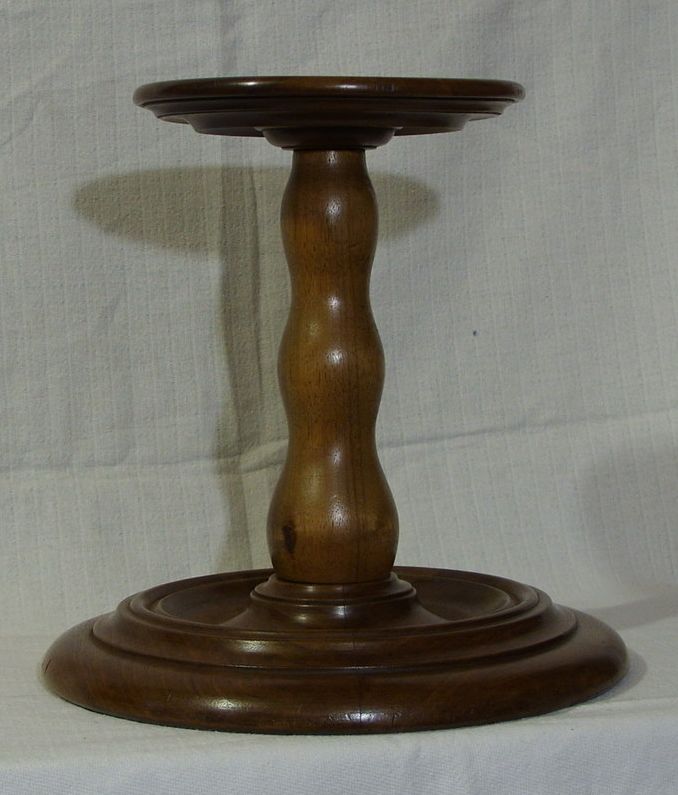
http://tinyurl.com/3vmm4zu PORTE LOUPE DE DENTELLIERE EN BOIS TOURNE
Size: 25.5 cm high, 25.5 cm base diameter.
Starting price: 3.00 EUR
Auction ends: Apr 11, 2011 12:57:17 PDT
Offered by: Ebay seller rapatord, la roche blanche, Auvergne, France
Comments: This is a turned wooden base meant to support a French Lacemaker’s Lamp.  I was concerned about the rather pristine condition – the seller says it has been cleaned and waxed.

Sold for 562.00 EUR, 8 bidders.

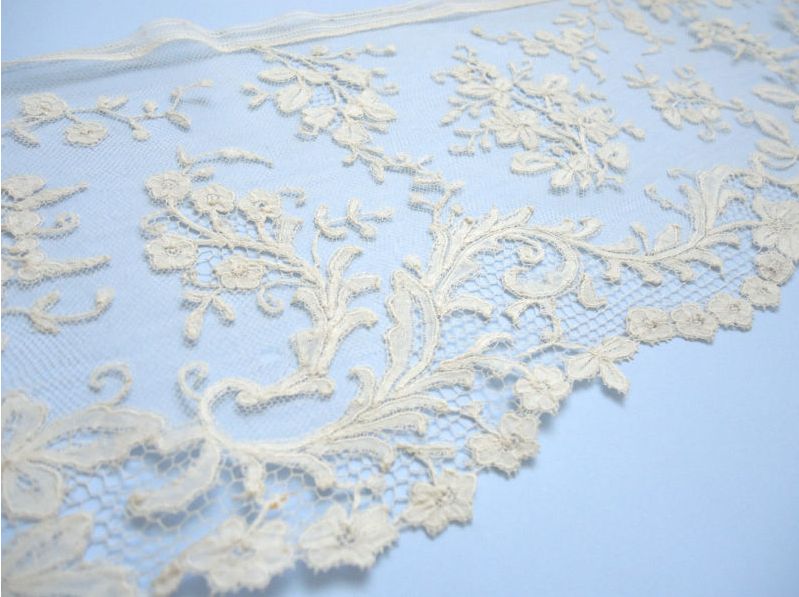
http://tinyurl.com/3aruwn5 19thC VERY FINE HM FLEMISH LACE W/POINT DE GAZE GROUND
Size: 6″ x 116″
Starting price: $9.99 with reserve
Auction ends: Apr 11, 2011 12:57:17 PDT
Offered by: Ebay seller snakey03rr, Bourbon, Missouri, United States
Comments: A funny piece, and the light blue background really makes it difficult to examine. The fine mesh seems to be Point de Gaze, and I can’t tell about the coarser mesh. But the motifs, which look like a good quality Bruges, appear to have been appliqued onto both types of meshes.  Probably a later 19th, early 20th c piece. Some small openings in the ground.

$150.00, 6 bidders, reserve not met.

Posted in Ebay Alerts! | Leave a comment

Lace of the Month: Spanish Blonde – April 2011

Since I recently did a piece on the Educational Silk Museum of Como which makes silk bobbinlaces a specialty, I thought it would be appropriate to select a piece of blonde lace for the April feature.  This impressive flounce is 7.5″ wide, and in excellent condition. The design is quite delicate, including half stitch shading and some interesting fillings. It does not appear to have been made in strips joined with point de raccroc.

One can get a good history of blonde laces in books like “Victorian Lace” by Patricia Wardle. Light silk laces were popular at the end of the 18th century, made in and around Chantilly, in Caen and Bayeux. Chantilly suffered much in the French Revolution, and revived largely because of the patronage of Napoleon. He decreed that only the products of Alençon and Chantilly could be worn at court, providing a great incentive for blonde lace manufacture. Blonde lace was so popular that it survived the fall of the Empire, and was a stable product of Chantilly and Caen for several decades. In Bayeaux the industry was re-introduced in 1827, and was quickly dominated by the August Lefébure firm. Through a careful study of popular fashion, he developed products for the Spanish and Spanish-American market. It is now difficult to disentangle products of France made for Spanish export, and products of Spain itself.  Some examples of Spanish ret-fi do have a distinctive architectural character, which will be discussed in later featured lace posts.

Blonde unfortunately was quite easy to duplicate with machine and embroidery techniques, and manufacture ceased to be productive by the mid 19th century.

Where did this particular example come from? It differs greatly from the familiar Blonde de Caen, which emphasizes large flat areas of floral design providing maximum contrast with a fine point ground. Note also the use of sprigs and tallies in the ground itself, and the unusual fillings used along the lower edge. Plates 241 and 242 in Florence May’s Hispanic Lace and Lace Making show  similar contrasting stitches labeled 18th century, but without the naturalistic effects seen in this piece.
I’m really leaning toward a Spanish origin on this piece.

Posted in About the featured lace | Leave a comment

Lace Event: Poole Bobbin Lace Circle Lace Day – June 4, 2011

Poole Bobbin Lace Circle Lace Day
Date:
Saturday, June 4, 2011
Place:
The Allendale Centre
Hanham Road, Wimborne, Dorset BH21 1AS, UK
Time:
10:30 AM until 4.00 PM

Speaker: Heather Toomer, “Fashion in Christening Gowns through the 19th Century”
Competition:
“Animals in Lace”

Tickets: Adult entrance only £4.50, junior £2.00.
£9.50, including Plowman’s lunch. please indicate your choice of either cheese or ham. Lunches must be ordered before May 21st.
Parking, Refreshments, Vendors, Facilities for the Disabled
Contact: PBLC Lace Day, c/o Mrs Barbara Jackson
595 Blandford Road, Upton, Poole, Dorset BH16 5EB,
Cheques payable to ‘PBLC’ with a stamped addressed envelope.
Telephone: 01202 624811
E-mail: barbara_jackson@live.co.uk

Posted in UK and Ireland | Leave a comment

Lace Event: North West Lace Group AGM and Lace Day

North West Lace Group AGM and Lace Day
Date:
Saturday, April 9, 2011
Place:
St. Georges Centre
Windmill Lane, Denton, Manchester M34 2JE
Come off the M60 at Junction 24 and take the Manchester Road(A57). Turn left at the first set of lights into Hulme Rd, continue to T-junction and then turn left onto Windsor Rd. Continue to T-junction and then turn right into Windmill Lane. Centre is just there on your left, before the parade of shops.

Time: 10:00 AM until 3:30 PM.  AGM at 11:00 AM.

Speaker: Chandra Law, “Batik Work”, and demonstration

Tickets: Visitors, £3.00

Leave a comment