
Wessex Lacemakers Suppliers Fair
Date: Saturday, February 19, 2011
Place: The Holiday Inn
Taunton (just off M5 junction 25), TA1 2UA
Time: 10.00 AM UNTIL 3.00 PM
Tickets: £3.00. Refreshments available
Contact: Rosemary Gay, 01935 824152
Wessex Lacemakers Suppliers Fair
Date: Saturday, February 19, 2011
Place: The Holiday Inn
Taunton (just off M5 junction 25), TA1 2UA
Time: 10.00 AM UNTIL 3.00 PM
Tickets: £3.00. Refreshments available
Contact: Rosemary Gay, 01935 824152

A striking floral Buckinghamshire design, 5″ wide. How does one tell Bucks point ground lace from all the other CTTT laces? Here are a few clues mentioned in literature, although drawing generalities too broadly can be dangerous. Local variations are often found.
1. Mesh angle – The mesh in Bucks is generally worked within a range of angles from 50 to 72 degrees, compared to 45 degrees for many other point ground laces. Good luck in trying to measure the angle – but it does give the mesh a slightly flattened appearance. It also makes the production of square corners difficult.
2. The gimp clue – Bucks is typically worked with the footside to the right. Position the lace with the footside on the right and look at the gimps where they are cut after working. Any remaining very short tails of the gimps should be positioned around the bottoms of the motifs, and should lie on top of the lace surface plane (assuming they extend far enough to overlap with some downstream work).
3. Use of the catch pin – How the weaver pair leaves a motif, connects with the mesh, and re-enters the motif, or how they form the outer footside edge varies a lot among different point ground laces. In Bucks the worker pair works through the passives/gimp, then twists 3 times, and makes a whole stitch with the adjacent pair. The returning weaver pair makes 3 twists before going back through the gimp/passives. The pin is placed to the side of the whole stitch – it does not split pairs.
4. But there is an even better way – find an original, documented pricking. My thanks to Diana Smith for thinking back many years to a visit that she and a friend made to the Aylesbury Museum to see their extensive pattern collection. She actually remembered this pattern! Here it is, from the Buckinghamshire County Museum collections. It was part of the large collection of Miss M. E. Burrowes of Maids Morton, first secretary to the North Bucks Lace Association, acquired by the Museum in 1936.
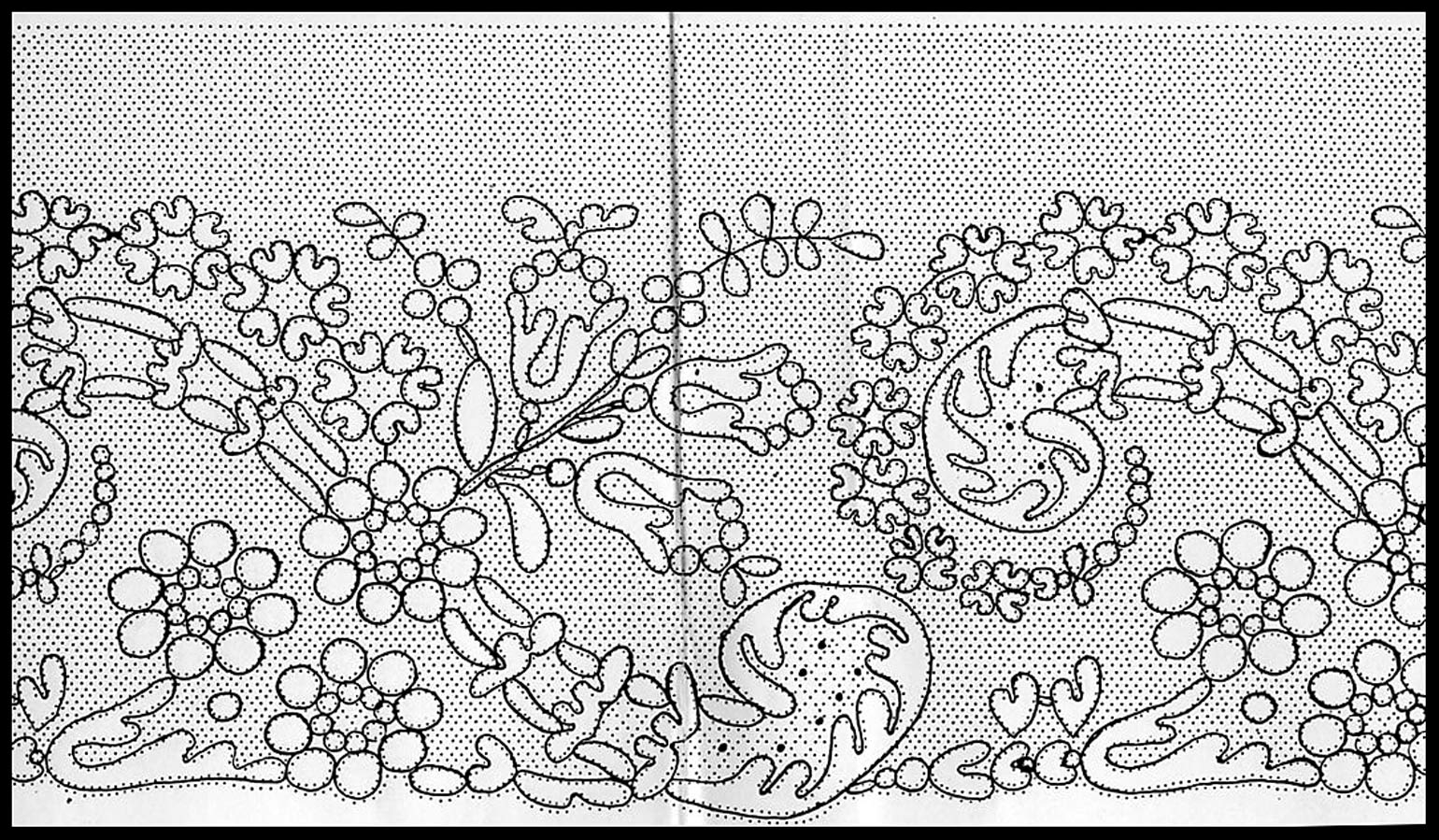
Obviously my example does not have the free space at the top, but otherwise it is a very close copy. Perhaps someone can come up with a name for this pattern. A similar pricking was apparently sold on Ebay a while ago.
http://tinyurl.com/23dqjd3 Spellewerkster in Oud Vlaams aardewerk A.Van De Voorde
Starting price: 19.00 EUR with reserve
Auction ends: Jan 01, 2011 07:05:28 PST
Offered by: Marcel Vanfleteren, Ebay Seller stekveugel, Torhout Belgium
Comments: A lovely little Vlaams Aardewerk lacemaker by Vande Voorde. Probably the smallest made by this pottery. I’ve bought several lacemakers from this seller.
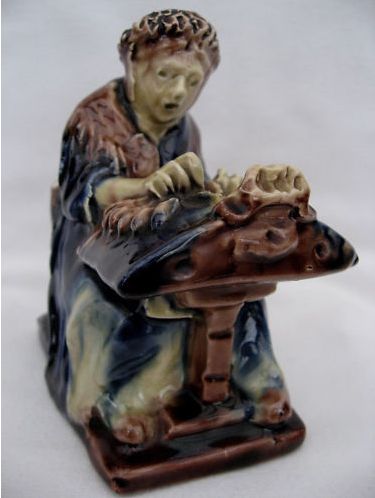 Sold for 76.50 EUR, 6 bidders.
http://tinyurl.com/2cf4ra9 BEAUTIFUL ANTIQUE BRUSSELS POINT DE GAZE LENGTH – ROSES
Starting price: $95.00 with reserve
Auction ends: Jan 02, 2011 07:31:14 PST
Offered by: Ebay Seller palexpo, Steinhausen, Switzerland
Comments: Good length of Belgian needlelace – point de Gaze type with raised petal roses. Good length and width. Designs on the rose petals is a plus. I do see some small holes in the net, and maybe a little repair work.
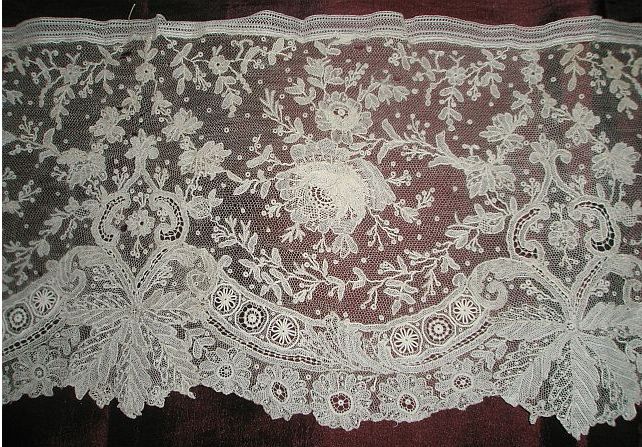 Sold for $400.00, 10 bidders.
http://tinyurl.com/232rxsh ANTIQUE BOBBIN LACE MAKER RARE FIND HISTORIC CRAFT ITEM
Starting price: AU $395.00
Auction ends: Jan 07, 2011 21:04:27 PST
Offered by: Ebay Seller harbour29, Yorke Peninsula, South Australia, Australia
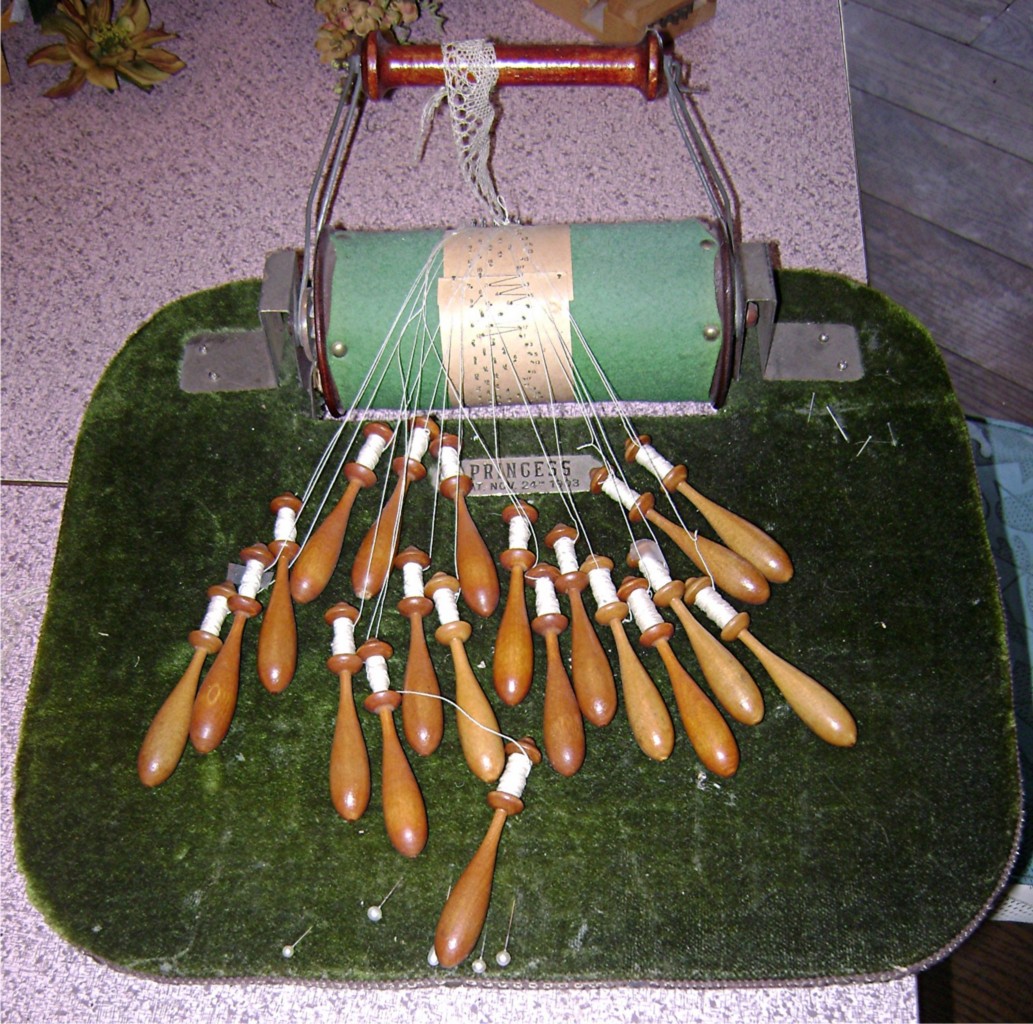
Comments: We don’t know why in the 1920’s the Torchon Lace Company (producer of the Princess Lace Machine in St. Louis, Missouri, USA) suddenly shifted operations to Melbourne, Australia. This is a rare Australian example of their equipment. I have one in my collection that is completely covered in brown velour – the fabric on this one might have been replaced. I don’t really know, we don’t have many comparables of this equipment. We do know that in contrast to American examples, the Australian ones do not have the metallic ‘Princess’ label fixed to the working surface.
The bobbins in this piece are of the right shape, but much rougher than known originals. A very interesting piece.
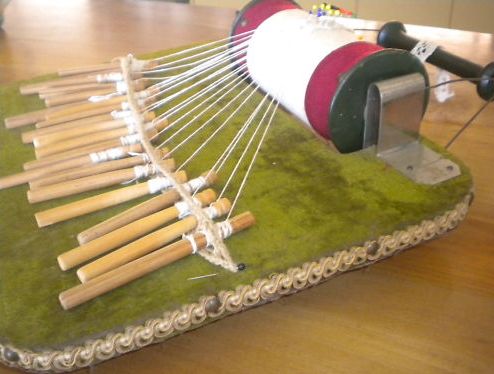 Did not sell.
I’ve had so many comments on this pillow that I’m putting up a (bad) photo of the Australian pillow and bobbins in my collection for comparison. I have the original bill of sale for this set. Note the straight bobbins, although they are a little more finished than the one in the Ebay posting. Curiously, the bobbins on my example are hollow more than halfway up their length. I have no idea why. Maybe the wood was naturally hollow, or maybe they were trying to reduce the weight?
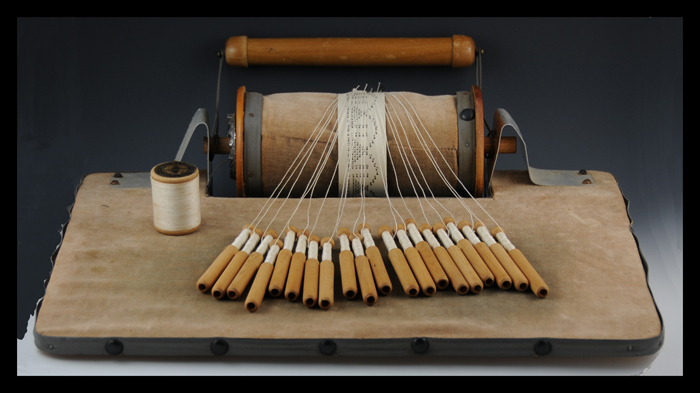
Look at the Ebay Alerts posting for December 12, 2010 to see an American Princess Lace Machine example, complete with original bobbins (I reproduce the thumbnail below). The American bobbins are a rather bulky Danish design. They hold a lot of thread and are well made and really very nice.
http://tinyurl.com/2ba2gv7 ANTIQUE LACE LARGE SCALE NEEDLELACE GROS POINT STYLE
Starting price: $150.00
Auction ends: Jan 04, 2011 18:16:37 PST
Offered by: Paivi Roberts, Ebay Seller greatlace, Paris – Palm Beach, United States
Comments: 19th or 20th century. It’s hard to say where this was made – similar work was done in Ireland, Belgium, Germany. Probably not from Italy. The shaped cordonnet are machine-made cords sewn on by hand. An interesting item.
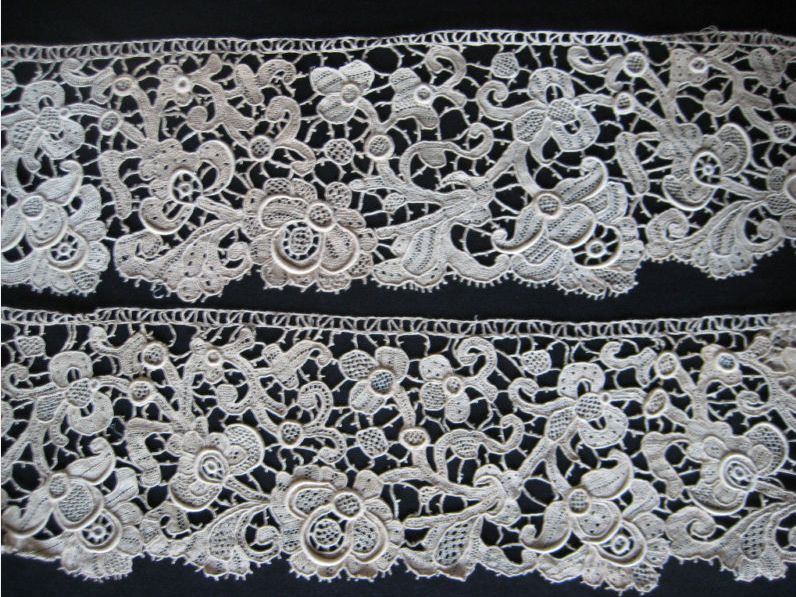 Sold for $150.00, 1 bid.
http://tinyurl.com/29jx52a MUSEUM QUALITY ANTIQUE POINT DE GAZE NEEDLE LACE HANKIE
Starting price: $1.00
Auction ends: Jan 04, 2011 07:58:40 PST
Offered by: Ebay Seller brett231, San Diego, USA
Comments: Yet another Belgian needlelace handkerchief. Enthusiastic design-but seems a bit heavy. The jour fillings are not of the quality that would really push this over the top. Condition looks very good.
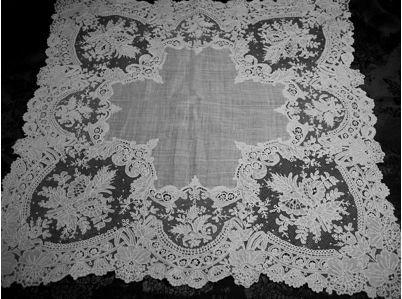 Sold for $416.01, 11 bidders.
http://tinyurl.com/26e8yks DENTELLE industrieà domicile belgique ed 1902 textile
Starting price: 99.99 EUR
Auction ends: Jan 02, 2011 10:22:30 PST
Offered by: Ebay Seller tigris59, briastre, Nord-Pas-de-Calais, France
Comments: One cannot underestimate the importance of this work, by Pierre Verhaegen. He wrote before WWI, and was a superb, first-hand observer. Much of our knowledge of Belgian lace of this period comes from this book. The work was actually done in two volumes – this is volume one. I see a number of ‘on-demand’ printed copies of this on ABEBOOKS, with a few originals.
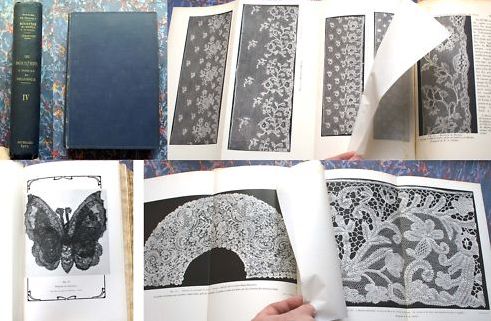 Did not sell.

3″ wide insertion of a typical Chebka diamond pattern from my collection. Probably made for the European market.
A very beautiful example combined with ‘Venise’ rosettes as described in the “Dentelles & Broderies Tunisiennes” book can be seen at http://textilecollection.wisc.edu/featured_collections.html. The design is similar to the work of Mlle M. Djellab shown at the bottom of page 36.
The Tunisian Republic is the northernmost country in Africa, and is also part of the five closely related Maghreb countries (Tunisia, Morocco, Libya, Algeria, Mauritania – also the disputed Western Sahara territory). Parts of these countries are separated from Africa by the Atlas Mountains and the Sahara, which promoted close contact with Mediterranean countries, particularly Italy, France, Malta, Sicily and Andalusia. Modern Tunisia was part of the Turkish Ottoman empire until it passed to a French protectorate in 1881. It became independent in 1956. In the face of violent protests stemming from the self-immolation of Mohamed Bouazizi on December 16, 2010, the government of Tunisia was dissolved on January 14, 2011 in what the media is now calling the Jasmine Revolution. Longtime president Zine El Abidine Ben Ali fled the country. The example of this one small nation (where women enjoy unprecedented rights among traditional Muslims), has shaken the entire world.
Chebka is a knotted freehand needlelace that was traditionally used for insertions to join together two pieces of cloth, although I am unable to find any working instructions on how this was accomplished. Similar to freehand bobbinlaces, it was traditionally worked without a marked pattern. This lace had several names depending on where it was produced. Chebka seems common to the cities of Tunis and Carthage, while the heavier Géma was made in Bizerte. There is a town called Chebka in Tunisia, but I cannot find a connection with the name of the lace. ‘Algerian’ and ‘Moroccan’ lace are terms occasionally used and may indicate the spread of this technique in neighboring countries, or perhaps they are just commercial names. The name ‘Arab’ lace was invented for the European market.
The art was not very robust when the French arrived, and several factions saw an opportunity for a revival. The lace changed both in character and in working methodology in response to European retail demand for a lighter, more flexible product. A finer cotton thread was introduced. Working methods evolved to use the stiff needlelace support composed of paper backed with layers of cloth. Workers used both long, narrow backings for the traditional insertion style (still with no marked design), and a larger square support for the newer complex patterns (where designs could be marked). The needlelace pillow seems to have been introduced to help speed production by allowing both hands to work freely. New designs breaking away from the straight insertion mode allowed the production of deep scallops, the development of backgrounds, and inclusion of knotted rosette motifs (‘Venise’) similar to Reticella.
Chebka is generally considered a single knot lace often with long spaces between knots. Much is made in technical descriptions of the Mediterranean laces in terms of single or double knots – I won’t go into detail here. Take a look at this interesting article http://textilecollection.wisc.edu/featured_textile_articles/oya.html to get some idea of the confusion over this matter. Again (see my Puncetto article) I repeat my call for someone to write the definitive work on Mediterranean and Eastern knotted laces, with solid, defensible research using all the formal textile technology methodology we can muster.
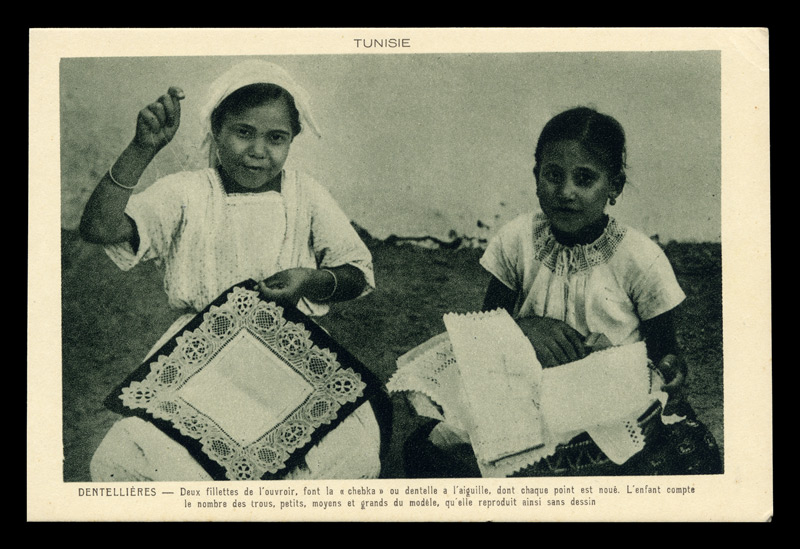


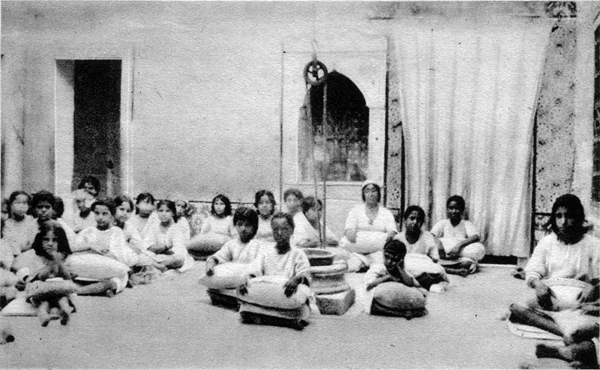
Above are three images on postcards, and one image of students seated at their needlelace pillows (taken from the Dentelles & Broideries Tunisiennes book discussed below). The postcards were produced by the Sœurs Missionnaires de Notre Dame d’Afrique – who come up repeatedly in African missionary lace-training efforts. They seem to have run a school for this lace associated with the Maison Lavigere in Carthage. This institution was named after Cardinal Charles Martial Allemand Lavigerie, founder of Catholic orders in Africa.
I am confused by the highly staged lefthand image in the second row (and more than a little uncomfortable with the offensive imagery). The lace seems to be Chebka, but the students don’t seem to be Tunisian.
Published literature is quite scarce on this lace. Thérèse de Dillmont in ‘The Complete Encyclopedia of Needlework’, describes Chebka lace technique, also under the name Arab Lace. The book was published (in French) in 1884, but I think this and the Puncetto sections was added in a later edition – I’ll try to track the exact date. The description is confined to insertions with a little scalloped edgework – there is no mention of working this lace on a pillow. It is described as a ‘looped’ thread lace with single knots. It is notable that Dillmont describes Puncetto lace technique using the ‘Continental’ needlelace hand position which draws the needle tip away from the body. Chebka is shown (and this is reflected in the other works discussed below) using the ‘English’ position which draws the needle tip toward the body.
The Cartier-Bresson manual shown below was written by the Sœurs Missionnaires de Notre Dame d’Afrique, and is a good, basic technical manual. I can’t find a publication date.

Click here to read Chebka. Set your web browser to ‘fit page’, and use the ‘Page Up’, and ‘Page Down’ keys on your keyboard for most effective viewing. Be patient, it takes a while to download.
The work shown below was written probably by the ‘A. Delplanche’ editor, and is an excellent historical resource. The author seems to have been one of those stimulating the resurgence of this lace in the first decade of the 20th century. Although technical instruction is minimal, the products of several designers and manufacturers are shown.
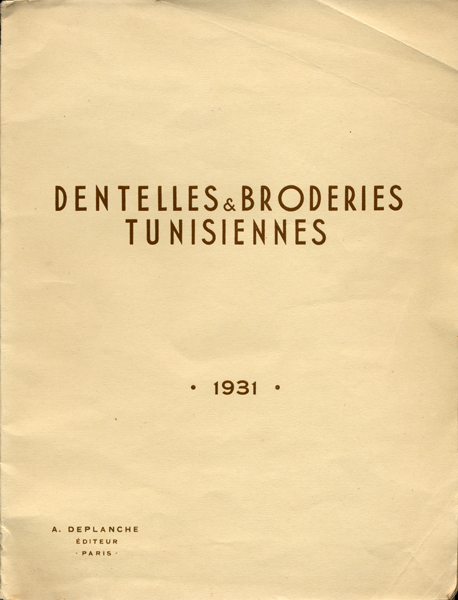
Click here to read Dentelles & Broderies Tunisiennes. This paperback book is quite rare and is 65 pages long, but only 41 of them concern lace. So for the moment, that’s all I’ve scanned in. A few of the rest of the photos show lace combined with embroidery, but my scanning hand is tired and my copy of this work is fragile.
Again, it’s a big file so be patient.
A third publication is “Dentelles Algériennes & Marocaines”, by Prosper Ricard, printed in 1928. The lace described is definitely Chebka-type, and I haven’t read enough of this book to discern the subtilties of Algerian and Moroccan variations, if there are any. It has 45 pages of text and 44 pages of plates. I need to think how to scan this since it is a little too wide for my scanner. More on this work will come later.

The Autumn, 1956 issue of Embroidery (the English journal of the Embroiderers’ Guild) has an article by Rachel Kay-Shuttleworth on this type of lace. I’m not sure I buy her argument about the similarities of this lace and Hollie point. Click Kay-Shuttleworth to download the article.
There is also some technical instruction in the March 1989 issue of “La Dentelle”, from the Centre d’Initiation a la Dentelle du Puy.
Resources on the web are gradually becoming available. The French blog “Dentelle et Papillon” has two pieces, the first containing some good instruction, the second discussing material mainly found in Dentelles & Broderies Tunisiennes.
http://dentelle-et-papillon.over-blog.com/article-la-chebka-40238891.html http://dentelle-et-papillon.over-blog.com/article-madame-seyrig-la-chebka-et-la-tunisie-42942557.html
Lace Fairy has posted an excellent piece from a very unique source, Monique Barns, who was born in Tunisia.
http://lace.lacefairy.com/Lace/ID/TunisianLace.html
I have yet to find any online videos discussing or demonstrating this lace.

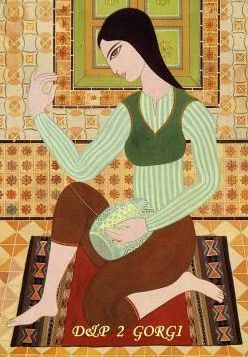
The craft of Chebka lace has not gone unnoticed by Tunisian artists. On July 21, 1980, Tunisa issued two stamps honoring handicrafts (Chebka lace and metalwork). Artist Safia Farhat, who is connected with several Tunisian stamps, drew the design. This is one of the most beautiful of all the lace-related postage stamps.
The image of a seated lacemaker working at her Chebka pillow is very appealing, and the prominent Tunisian artist Abdelaziz Gorgi (1928-2008) produced the righthand image shown above. Note the two different orientations of the pillow in these images, which may be artistic license, or may be repositioning of the work to follow a desired pattern. Both artists show quite a fascination with hand position, which may exaggerate reality, but only slightly.
http://tinyurl.com/2g4n3gn Magnificent Antique Filet Lace Table Runner circa 1920s
Starting price: $112.50 Buy-it-Now
Auction ends: ~ Dec 31st
Offered by: Ebay Seller cork123, Cleveland, Ohio
Comments: Filet works aren’t easy – there is so much second-rate material out there, and there are few good resources for the collector on the subject. And it is extremely difficult to attribute a source for any of these objects. But I like this one a lot – bold, innovative design with a definite Arts & Crafts appeal. Good embroidery technique with well finished edges. Condition appears excellent.
 Sold for $112.50
http://tinyurl.com/2c43omk ANTIQUE LACE-BRUSSELS LACE STOLE,VEIL
Starting price: $405.00
Auction ends: Dec 29, 2010 05:17:23 PST
Offered by: Maria Niforos, Ebay seller mithya, London
Comments: A nice bobbinlace applique shawl, looks like machine net (pretty sure, not enough closeups to tell 100%). Pieces like this frequently suffer over the years from laundering, rust and tears in weak net. This one looks in very good condition, and shows signs of a few small repairs. Edges look a bit frayed in some places. Nice cohesive design – a good example of the genre, but nothing spectacular.
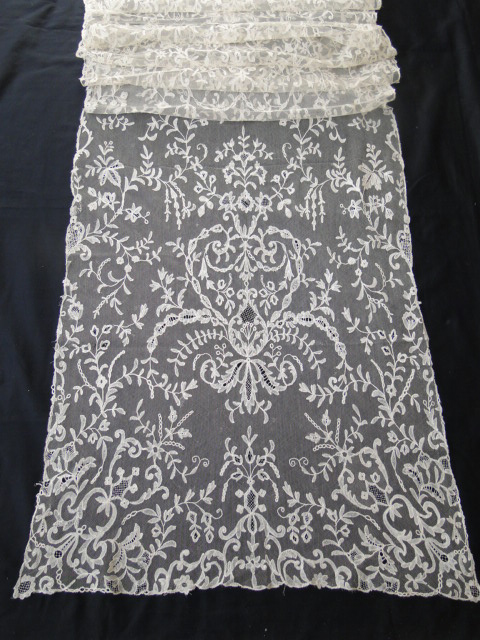 Did not sell.
http://tinyurl.com/2g5s5p6 RARE 19THC. BRUSSELS LACE SHAWL W/POINT DE GAZE
Starting price: $45.00
Auction ends: Dec 28, 2010 16:55:24 PST
Offered by: Maria Niforos, Ebay seller mithya, London
Comments: The lace itself is a fairly standard Duchess-Point de Gaze Rosepoint, which was often commercially marketed as Duchesse de Bruxelles when it was made (later in the 19th c). But the form is quite interesting. I’m guessing that the long lappets are meant to edge the front opening of the dress, which might put this piece in the late 19th early 20th centuries. I see a few small brown spots, but overall very good condition.
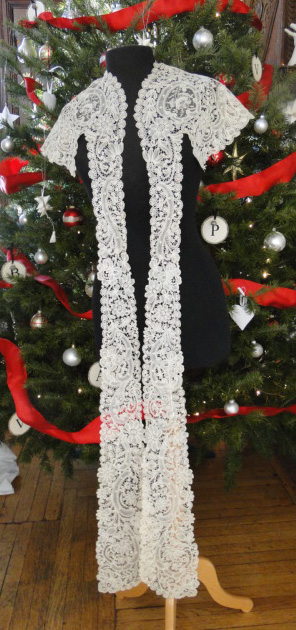 Sold for $1,200.00, 4 bidders
I’m leaving on Christmas vacation tomorrow, and will post the Ebay Alerts today instead of Thursday. I really wasn’t much impressed with current offerings, so will leave you with only one item this time. And wishes for a very happy Holiday!
http://tinyurl.com/29k6dnu Mario Vellani-Marchi 1957 Burano Original Italian
Current offer: $195,000.00 no bids
Auction ends: Dec 31, 2010 12:04:49 PST
Offered by: Ebay Seller mac4141, Washougal, WA, United States
Comments: Mario Vellani-Marchi (1895-1979) was a painter, draughtsman, printmaker, stage designer and illustrator. He worked for many years in Burano and produced a number of images of lacemakers. One of the most famous is “La Rossina merlettaia”. This is not that work, but a similar one with apparently impeccable provenance.
And the seller takes Paypal!
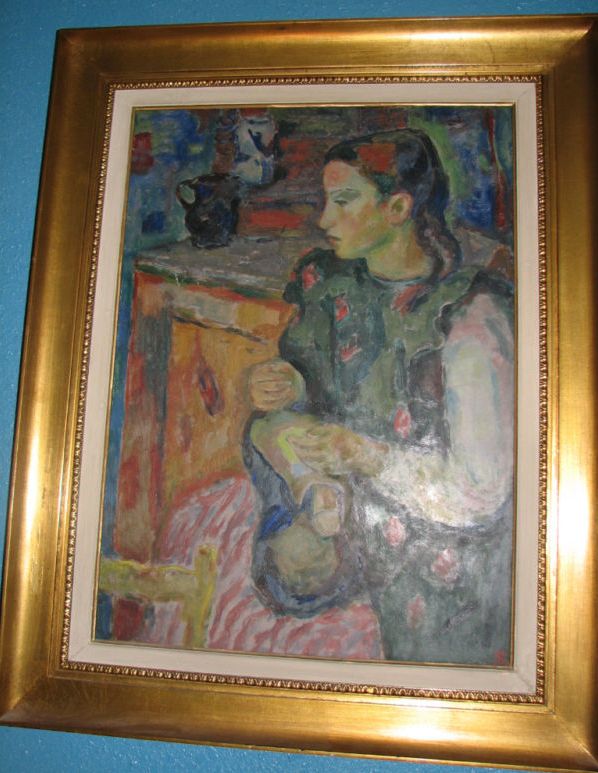
Sale ended on Dec 23rd, no known bids. I emailed the seller, who said the work would be relisted along with several others. He has also contributed a lovely comment to this post.
The piece has been relisted for $495,000.00. He also shows a few other Vellani-Marchi Burano lacemaker portraits in the posting.
Ebay listing 230569184198, the price is now down to $9,500.00.
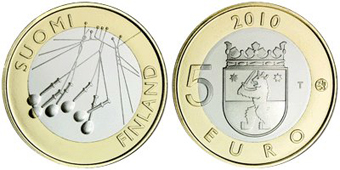
http://tinyurl.com/29zyx54 5 Euros Finlandia 2010 Bolillos bimetalica @ NOVEDAD @@
Current offer: 12.00 EUR, buy-it-now, 19 available
Auction ends: ~ Dec 22
Offered by: Ebay Seller vivescortada, Barcelona, Spain
Comments: Finland is issuing commemorative Euro coins highlighting aspects of everyday life in the nine traditional Finnish provinces (administratively, there are only six). Satakunta is honored in the second 5 Euro coin in the series, just issued. Rauma, the most famous of the Finish lace centers, is located in Satakunta province. 90,000 regular and 30,000 proof coins have been issued. The proofs can also be bought from the Mint of Finland http://tinyurl.com/29gv454 online for 22.50 euros. I’m not sure if the Ebay one is a proof coin, but it does say it’s uncirculated. A proof example is shown below. I think the Ebay one is contained in a plastic folder that isn’t too clean.
http://tinyurl.com/27ng5zw LIVRE ANCIEN ART DENTELLE FUSEAUX CARLIER LANTSHEERE
Current offer: 470.00 EUR, 1 bid
Auction ends: Dec 23, 2010 11:57:49 PST
Offered by: Ebay Seller citronnier25, Provence-Alpes-Côte d’Azur, France
Comments: A beautiful example of Antoine Carlier de Lantsheere’s “Trésor de l’art dentellier. Répertoire des dentelles à la main de tous les pays depuis les origines jusqu’à nos jours.” Published in 1922. The work was reprinted in 2005; you can buy it on the Chapiter site for 52.25 EUR http://tinyurl.com/2fbnnys. This author wrote extensively on lace history – I’ve identified several of his works dated from 1889 to 1922.
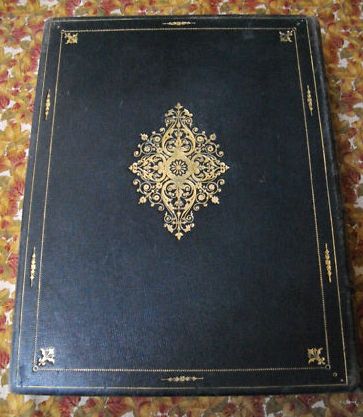 Sold for 470.00 EUR
http://tinyurl.com/29hy6co ORNATE 19THC. LE PUY LACE SHAWL
Current offer: $175.00, no bids
Auction ends: Dec 20, 2010 15:49:51 PST
Offered by: Maria Niforos, Ebay Seller mithya, London and New York
Comments: I’m not really sure about the Le Puy attribution. This type of lace is often seen in white silk. It has very distinguishing characteristics, like the eight-petal flower. It’s a good example, and seller notes only minor condition problems with edge threads.
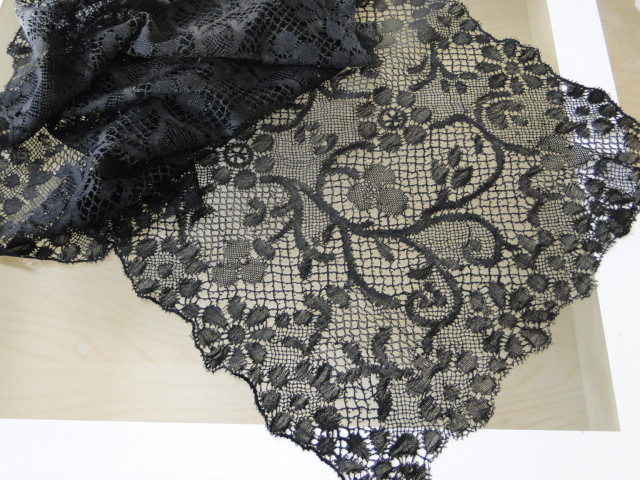 Did not sell. Relisted for $175.00.

The cover of Harry’s Monkey, 6-1/4″ x 4-3/8″. It was published together with another morality story, “How Sadie Slipped”, by Jennie Chappel.
Here begins a new category on LaceNews. Lace related themes have been used in literature for many years, and come from a wide variety of sources, many long forgotten. To bring these works to the attention of the lace community after so many years is in itself news. They are especially interesting in that we can learn something about the evolution of lace terminology.
When we view some of these with our present day perspective and attitudes formed by the Civil Rights movement, there are passages that are a little hard to take. So be prepared; some of the content of the earlier books is not readily acceptable.
Among earlier lace literature are morality tales, often written a strong religious bias. There are two definite camps here, roughly along the Catholic and Protestant lines. I’ll cover the former in another post, but the latter can produce some surprisingly inventive stories, as is often typical of children’s literature in any age. Among these is a work by Mrs. C. E. (Charlotte Elizabeth Richmond) Bowen (1817-1890) called “Harry’s Monkey; How it Helped the Missionaries”. The book I am showing here was published in 1890, although one reference shows it first published in 1866 as “Harry’s Monkey; How it Saved the Missionaries”. See http://tinyurl.com/28w7asg for a good listing of her works. This references notes that works of Sarah Schoonmaker Baker were sometimes attributed to Bowen – I do not know if this applies to Harry’s Monkey.
There is virtually no information about Charlotte Bowen on the Internet, other than her birth/death dates, and a few listings of her stories in catalogs. She produced many morality tales for children, such as “How Paul’s Penny Became a Pound”, and “How Peter’s Pound Became a Penny”. Enough said. Her works were published both in England (S. W. Patridge, London) and the US (E. P. Dutton, New York). Her story, “Sybil, and Her Live Snowball” has recently been reprinted.
The plot of Harry’s Monkey concerns Harry’s efforts to earn money to help the missionary effort in Africa. (Try to view the description of the benefits of such activities in this story in the light of the 1860’s – things are obviously different today). He is able to train his pet monkey to do various tricks to entertain at children’s parties – among the tricks is bobbinlace making. The 10 pounds, 13s 6d he finally is able to contribute to the cause would be worth about 871 pounds using the retail price index for 2009. That would be about $1,400 today, although the exchange rate has varied a lot this year.
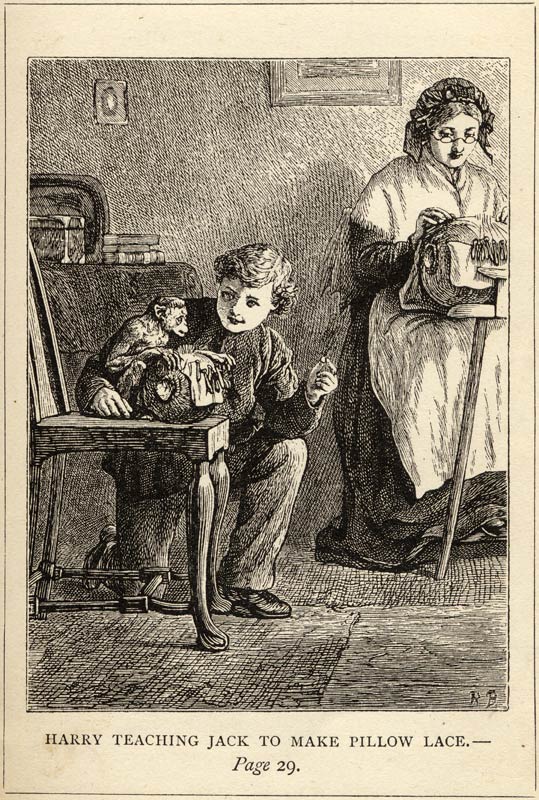
Click here to read Harry’s_Monkey. Set your web browser to ‘fit page’, and use the ‘Page Up’, and ‘Page Down’ keys on your keyboard for most effective viewing.
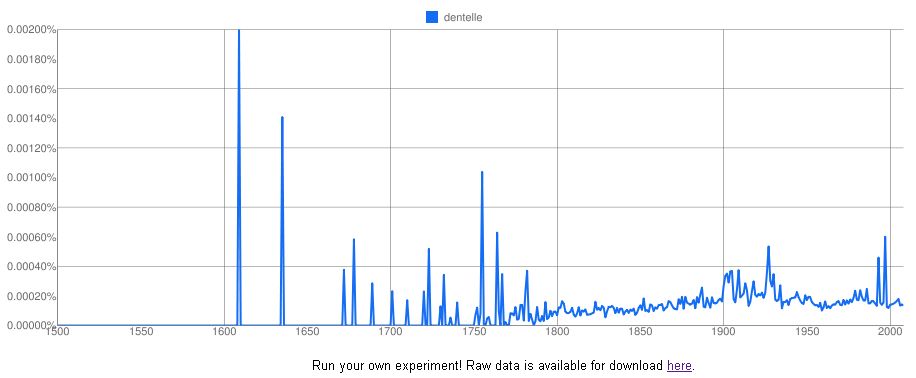
On December 16, 2010, Google launched a new tool called ‘Ngram Viewer’ at https://books.google.com/ngrams. Anyone driving to work and listening to NPR got a quick preview – I’ve been playing with it ever since. This utility is a direct result of Google’s massive book scanning program. Some sources say that 4% of all the world’s books have currently been scanned, while other sources say 11%. It allows the user to search for up to five word phrases contained in this database spanning the years 1500 to 2008. Presenting results as data rather than as coherent sentences avoids lots of trouble with copyright laws.
A paper in the journal Science has been published on this work http://www.sciencemag.org/content/early/2010/12/15/science.1199644. You do have to have a subscription to the AAAS (American Association for the Advancement of Science) to get it. I’ll give a report on the paper later as a comment to this post.
An ‘n-gram’ is formally defined as a subsequence of n objects from a defined sequence. Google appears to be using this term in the context of the number of adjacent words in their word database. So the word ‘lace’ would be a unigram, ‘Alencon lace’ a bigram, etc. You can search for up to five words, and that restriction is probably due to unreasonably long searchs time as ‘n’ increases. The user can also choose from material organized into 10 different ‘language’ categories or ‘corpora’. For example, a search on the word ‘lace’ in the English corpus gives the following:

Chosing the ‘British English’ corpus, which is a subset of works in English but published in England, the result is:

Obviously the algorithm isn’t going to distinguish between the textile ‘lace’ and something like ‘lace’ up your shoe. So you have to use this with caution. Case also matters, so searching for ‘Lace’ is different from searching for ‘lace’. And the ngram must appear in 40 different works in order to show up on the graph. I’m not sure if that holds true for the very early books, or for a subset corpus like British English, which may account for some of the differences between these two graphs.
The entire database is searched for your ngram, and the number of times that the ngram appears is counted for every year. That value is normalized by the number of books published in that year, and this is the quantity plotted on the vertical axis. I assume this means that if the ngram is used more than once in a single book, all the instances of usage are counted. If there were very few books published in one year, you will get a spike – this can be smoothed by averaging over nearby years with the smoothing parameter. (Actually, I’m starting to rethink this – the count may be over the number of books that terms appear in, otherwise the percentages could get greater than 1.0.).
Here are a few more searches – first on the term ‘dentelle’ in the French corpus (caution, dentelle can also be associated with teeth and jagged mountains):
Several search terms can be plotted on the same graph. Below is shown searches for “Alencon lace”, “Valenciennes Lace” and “Chantilly lace” in the English corpus using a smoothing factor of 2 (meaning the data is averaged over the two previous and two following years). I couldn’t find anything earlier than the spike around 1745. The English search did not seem to understand the ç in ‘Alençon’, but did pick up ‘Alencon’.

What does this all mean? The first appearance of terms is quite valuable, if you understand the definition of the search term at the time it was published. Unfortunately you cannot learn what specific book contained the phrase. I have a feeling that the shapes of the curves are influenced by the normalization process – think about what happens if a term is mentioned many times in just a few books.
Databases can be downloaded for the user to do their own searches, and this will certainly help understand the process. I’ll revise this post as I learn more about this fascinating utility.
http://tinyurl.com/29lbquo Uraltes Klöppelkissen mit Ständer+Zubehör um 1910 !!
Current offer: 58.00 EUR, 6 bids
Auction ends: Dec 19, 2010 11:23:46 PST
Offered by: Ebay Seller sammeln123, Chemnitz, Germany
Comments: A wonderful Art Nouveau Klöppelständer – quite an innovative form. German stands come up for sale all the time, but the Art Nouveau ones are very rare. I’m guessing that the pegs used to fix the height of the inner piece are missing, or might be in the bag of bobbins? Otherwise, apart from a few scratches, condition looks good.
 Sold for 234.99 EUR
http://tinyurl.com/23bhfay OLD ITALIAN LACE [Lbc]
Current offer: $299.95 Buy it Now
Auction ends: ~Jan 13, 2011
Offered by: Ebay Seller kenpa, New Jersey, USA
Comments: The classic 2-volume English version of Elisa Ricci’s Antiche Trine Italiane (1908). See Bianca Rosa Bellomo’s outstanding Italian site http://tinyurl.com/28slnfq for everything you ever wanted to know about Elisa Ricci.
This translation, published in 1913 remains one of the best references on Italian lace, and the photography is great. It has recently been reprinted (poorly), and also scanned in for publication on the web at several sites (see the Arizona Textile Library version at http://tinyurl.com/2flundj).
 Ended, relisted with reserve http://tinyurl.com/2gy2wsm.
Sold for $225.27
http://tinyurl.com/2cw7agc ANTIQUE HAND MADE RUSSIAN PEASANT LACE LAPPETS
Current offer: 9.99 GBP, no bids
Auction ends: Dec 22, 2010 03:45:33 PST
Offered by: Ebay Seller dianavee52, Cornwall, UK
Comments: An interesting lappet scarf, with impressive design using a simple bobbinlace tape technique. It is actually Russian Yelts lace.
 Sold for 21.55 GBP, 4 bidders
http://tinyurl.com/29g4pap Lg Antique Vtg Brussels POINT DE GAZE LACE Handkerchief
Starting price: $199.99, no bids
Auction ends: Dec 21, 2010 18:03:47 PST
Offered by: Ebay Seller adtjmd, Hickory, North Carolina
Comments: Yet another Point de Gaze-type Belgian needlelace handkerchief. I like this one, good design paying attention to overall effect rather than just adding frills. Condition appears very good.
 Sold for $255.00, 3 bidders.
http://tinyurl.com/279tcxx HM Antique Vtg BRUSSELS APPLIQUE NET LACE Parasol Cover
Current offer: $9.99, no bids
Auction ends: Dec 19, 2010 18:11:49 PST
Offered by: Ebay Seller adtjmd, Hickory, North Carolina
Comments: Interesting piece, looks very Belgian, maybe Liersekant? It is an applique of a net-like material fixed with tambour stitches. A few small holes, but overall looks good.
 Did not sell.
http://tinyurl.com/2d7u8eh RARE MALTESE LACE FAN W/MOTHER OF PEARL ENGRAVED STICKS
Current offer: $45.00, no bids, reserve not met
Auction ends: Dec 20, 2010 04:43:38 PST
Offered by: Maria Niforos, Ebay Seller mithya, London-New York
Comments: Maltese fans don’t come up too often-I think the lace is sometimes a bit too heavy to be really practical. This is a nice example with a central pattern typical of Gozo work, which can also be a lot lighter than other Maltese designs. Condition looks very good.
 $102.51, reserve not met.
http://tinyurl.com/2dcm235 ANTIQUE LACE- CIRCA 19THC. LILLE LACE APRON
Current offer: $225.00, no bids
Auction ends: Dec 20, 2010 16:28:34 PST
Offered by: Maria Niforos, Ebay Seller mithya, London-New York
Comments: An impressive, unusual piece. Seller warns about condition, but it looks pretty good from the photos.
 Sold for $483.99
http://tinyurl.com/2d356eg ANTIQUE LACE-CIRCA 1770,FINE MECHLIN LACE
Current offer: $45.00, no bids, reserve not met
Auction ends: Dec 20, 2010 06:03:17 PST
Offered by: Maria Niforos, Ebay Seller mithya, London-New York
Comments: Nice 2nd quarter 18th c Mechlin length – narrow but very long. Snowflake fillings. I’m thinking that the picot edge might be a later addition – not enough closeup photos to tell definitively. It’s a common 19th c ‘improvement’ since the slight picots of the original weren’t in fashion. Usually not difficult to remove, if desired.


